Dr. Grace Taylor started school in Alexandria as a student at George Mason Elementary. Since Aug. 12, she has led the whole school division as acting superintendent of Alexandria City Public Schools↗ET.
"Growing up as an Alexandria City Public School (ACPS) student and spending my career here gives me a deeply personal perspective on our school division. Serving in this leadership role is truly the pinnacle of my career; to begin my educational journey in our classrooms and to now have the honor of serving as acting superintendent is a privilege and honor I do not take for granted," Taylor said in written answers to The VAEdTribune, provided through the division's communications office.
The Alexandria City School Board appointed Taylor at a special called meeting on Aug. 12, the same day Superintendent Dr. Melanie Kay-Wyatt's tenure ended. ALXnow reported that the board and Kay-Wyatt had agreed to move her resignation date up from Oct. 1. The board's announcement said Taylor would serve until the next superintendent is hired and able to begin. On Oct. 8 the board named Dr. Jharrett Bryantt, now superintendent of the Anchorage School District in Alaska, as that next superintendent, effective Feb. 1, 2027. Taylor leads the division until then, through the first half of the school year.
A career that keeps coming back to Alexandria
Taylor's own schooling ran through George Mason Elementary, George Washington Middle School and T.C. Williams High School, the school now called Alexandria City High School, according to the division's biography. She later returned as a principal, leading George Washington Middle School, the Minnie Howard School and John Adams Elementary School. The Washington Post gave her its Distinguished Educational Leadership Award while she led Minnie Howard.
She also worked in the superintendent's office as a principal on assignment, where the division credits her with starting its partnerships with the George Mason University Early Identification Program and with Advancement Via Individual Determination (AVID), and with launching the Senior Experience for college and career readiness. She served as executive associate principal for special education at the high school she had graduated from.
Her career has also taken her well beyond the city. She was a high school principal in Boulder, Colorado, and in Atlanta, and in Fairfax County Public Schools she worked as Cluster 5 director and later as interim assistant superintendent and executive principal for Region 3. She returned to ACPS as chief of staff in December 2023, working for Kay-Wyatt on the management of the superintendent's office. Beginning in September 2025, she also filled the vacant chief operating officer role on an interim basis, overseeing facilities and operations while the division searched for a permanent hire.
She holds a bachelor's degree in history from Emory University, a master's and an educational specialist degree in educational leadership from Georgia State University, and a doctorate in educational leadership from Virginia Tech.
"Having walked in our students' shoes and served across various roles in the division, I hold a deep understanding of our community's deep history, strengths, and unique opportunities. It grounds my leadership in empathy, accountability and a commitment to ensuring every student in ACPS receives the same strong foundation and high-quality education that shaped my life," she wrote in response to our questions.
Enrollment growth through 2024-25
The division Taylor leads has grown for most of the past two decades. Virginia Department of Education figures put Alexandria at 16,613 students in 2024-25, the endpoint of this profile's historical enrollment comparison and the highest count within its 2002-03 through 2024-25 window. Enrollment bottomed out at 10,334 in 2006-07; the 2024-25 count is about 61 percent higher.
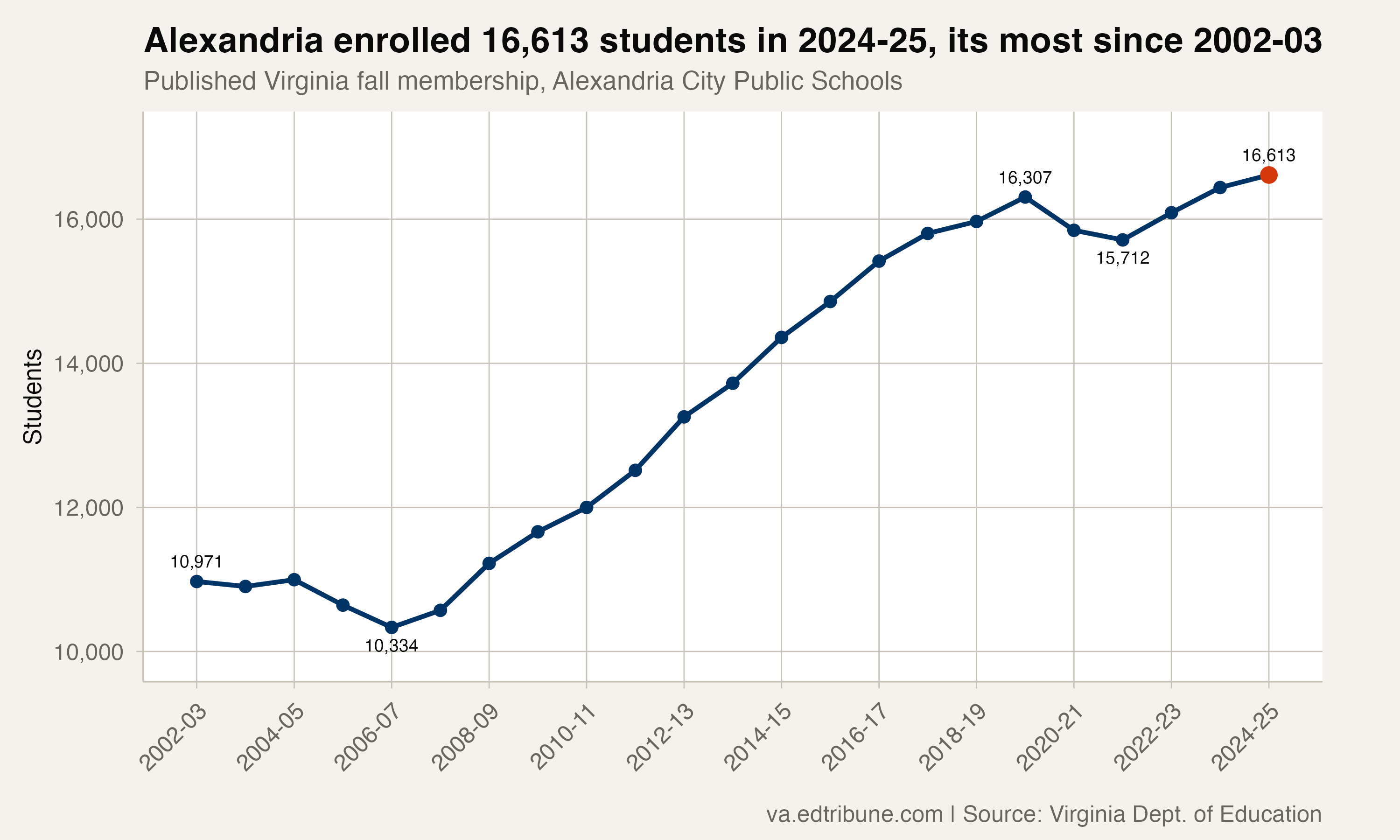
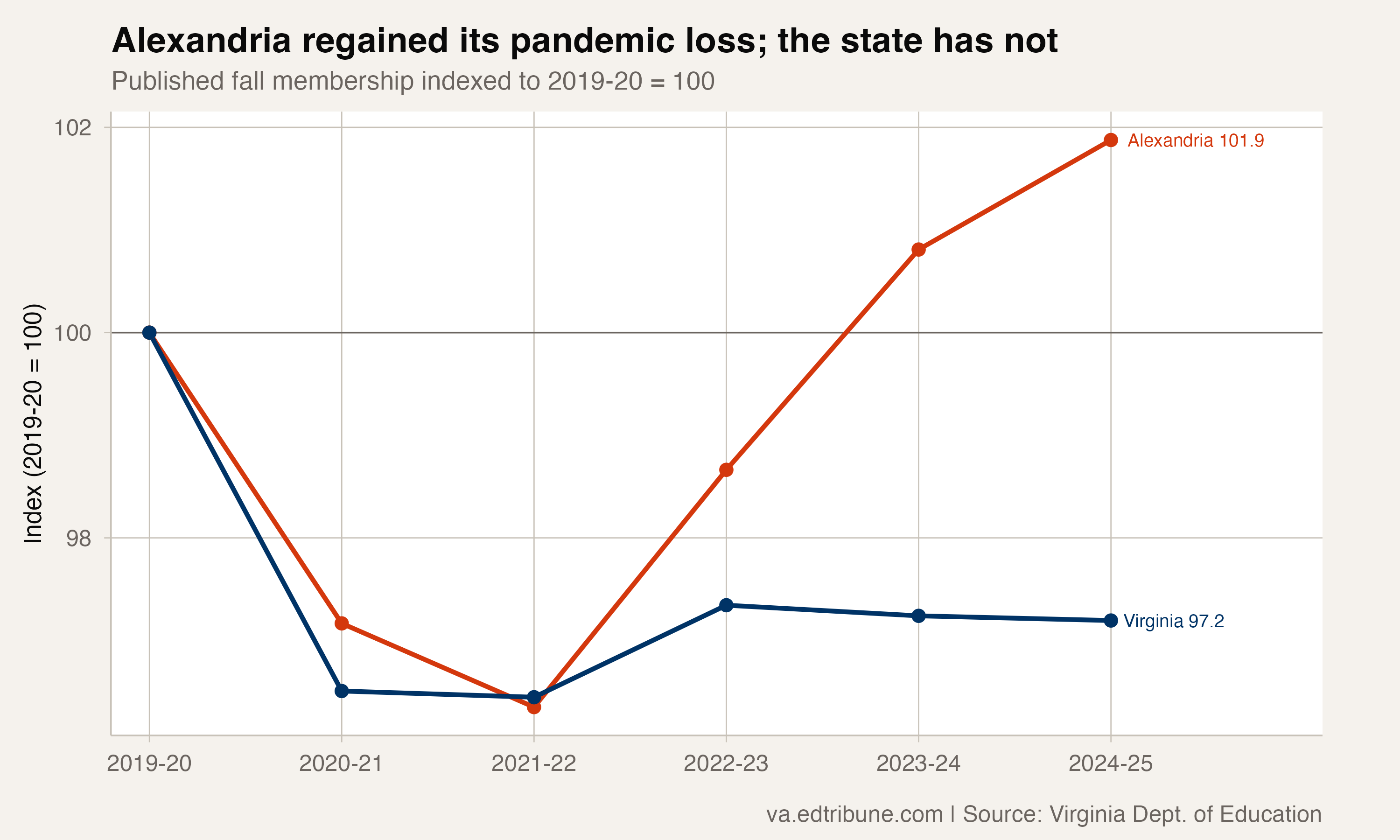
Alexandria lost students during the pandemic, falling to 15,712 in 2021-22, and then gained them back. By 2024-25 it enrolled 306 more students than in 2019-20. Statewide enrollment was 2.8 percent below its 2019-20 level in 2024-25. Among Virginia's 131 school divisions, Alexandria ranked 16th by enrollment in 2024-25. These enrollment comparisons retain that historical window; they do not describe current enrollment.
The enrollment files do not record why families come to or leave a division, so they cannot say what drove the growth.
Who those students are
No single group is a majority of Alexandria's students. In 2024-25, Hispanic students made up 38.0 percent of enrollment, White students 26.7 percent, Black students 23.5 percent and Asian students 6.6 percent.
Taylor's answers return often to instruction and support. "We must continue investing in rigorous instruction, specialized learning supports, and expanding equitable access to high-quality learning materials and experiences across all grade levels," she said in written answers.
The state's figures show the scale of that work. Alexandria counted 7,476 English learners in 2024-25, 45.0 percent of its students, compared with 14.9 percent statewide. That count rose by 636 from 6,840 in 2022-23, more than the division's total enrollment grew over the same two years. The file cannot separate new arrivals from changes in how students are identified or reclassified. Alexandria also served 2,074 students in special education in 2024-25, 12.5 percent of enrollment. Both groups overlap with each other and with every racial and ethnic group, so their shares are not parts of a single whole.
Safety, well-being and showing up
"Above all, it is imperative that our schools remain safe, welcoming, and caring spaces where every student feels known, valued, and empowered to focus on learning," Taylor said in written answers. "As we look to the year ahead, we are focused holistically on both the academic and social-emotional needs of our students."
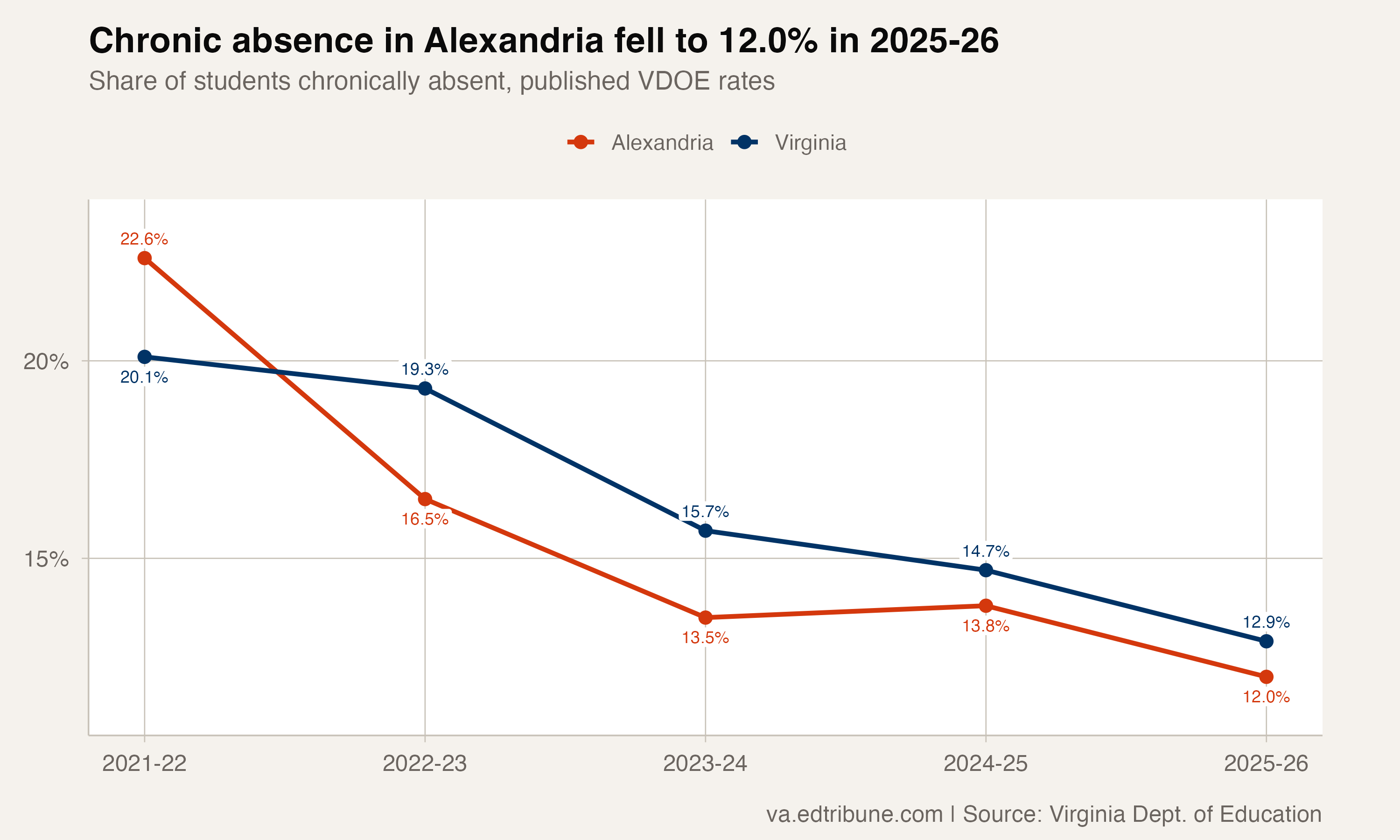
The state's attendance data offer one window on that. In 2025-26, last school year, 12.0 percent of Alexandria students were chronically absent, below the statewide rate of 12.9 percent. In 2021-22 the division's rate was 22.6 percent. The attendance files do not record which efforts schools made, so they cannot show what moved the rate.
"Equally crucial is supporting our students' mental health, well-being, and physical safety so that every child feels secure, cared for and empowered to thrive in college, career and community," she added in written answers.
Families first during a handoff
Asked what she wants families to know about her priorities during the transition, Taylor started with partnership.
"Family partnerships are critical to the success of our students and school communities, and building these trusting relationships is a priority as we work together to increase student achievement across all of our schools," she said in written answers. "During this transition, every decision we make will center on directly supporting high-quality classroom instruction and student growth."
In response to our questions, she described the channels families can expect: "Families and students can expect transparent communication and authentic, two-way dialogue, whether through personalized communications, school updates, weekly newsletters, or direct engagement at Parent-Teacher Association (PTA) and or community meetings."
Her assignment has a set end. Bryantt is scheduled to take over on Feb. 1, 2027, and the months before that handoff fall to an educator who started out in Alexandria's classrooms.
Enrollment and attendance figures come from the Virginia Department of Education, which publishes fall membership and chronic absenteeism data by school division.
Detailed code that reproduces the analysis and figures in this article is available exclusively to EdTribune subscribers.
Discussion
Sign in to join the discussion.
Loading comments...