Virginia reported that 49.1% of its students identified as homeless were chronically absent in 2022-23, meaning they missed at least 10% of the school year. That is 7,687 students, according to the Virginia Department of Education's statewide chronic absenteeism file.
The rate for all students was 19.3%, so students identified as homeless were chronically absent at about 2.5 times the statewide rate. It is the highest rate among the 13 student groups VDOE reports. The next highest, for economically disadvantaged students, was 27.5%.
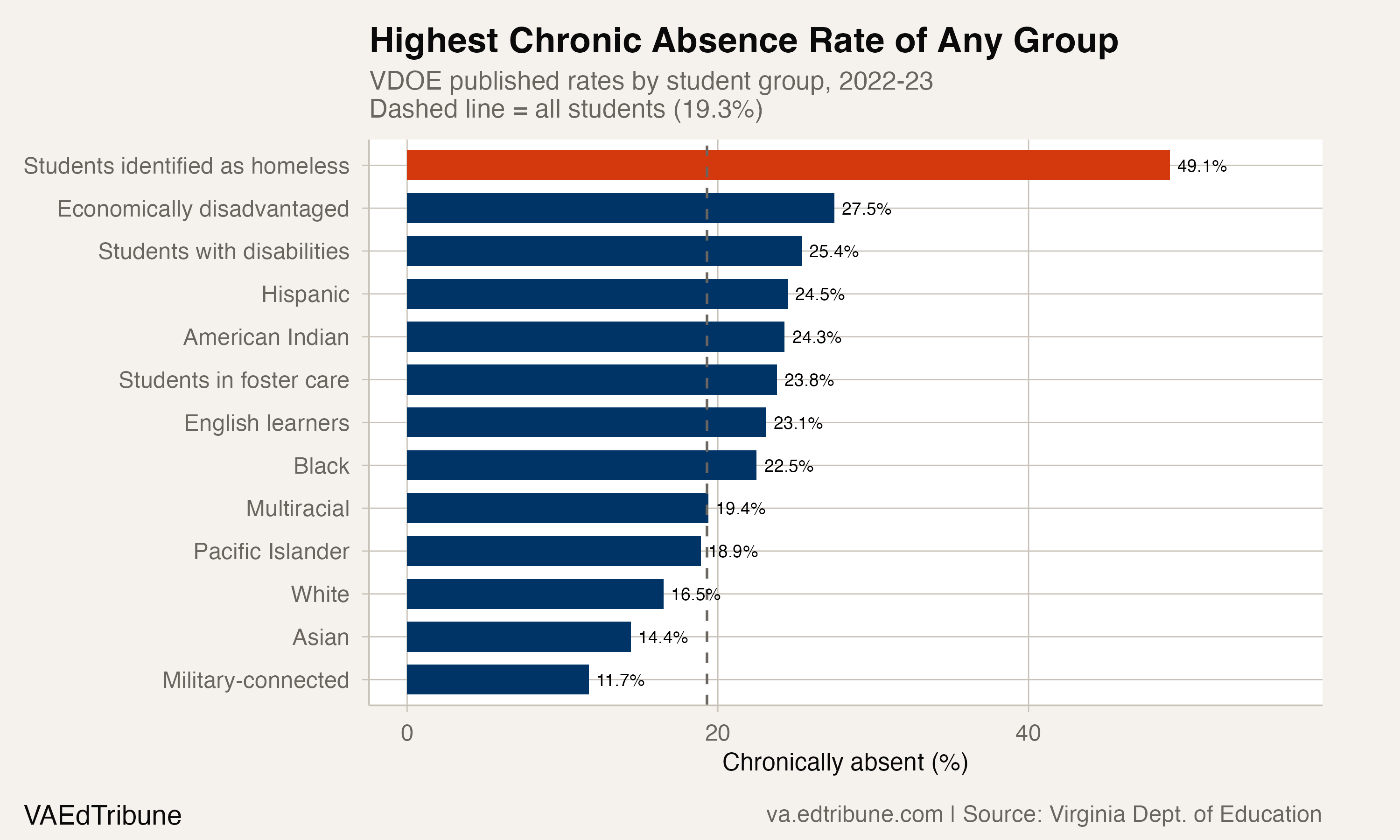
Students identified as homeless make up 3.3% of Virginia's 236,104 chronically absent students. The rate is the clearer measure: nearly one in two students in the group crossed the threshold, against about one in five statewide.
A year earlier, in 2021-22, VDOE reported a 50.9% rate for the same group, with 6,032 students chronically absent. The rate fell 1.8 percentage points in 2022-23 while the count rose by 1,655 students, which means VDOE counted more students identified as homeless in the second year. These are the two most recent years of statewide absence data available for this analysis.
Division by division
VDOE also publishes the count and rate for each division. Among the 15 divisions with at least 100 chronically absent students identified as homeless, which together account for 5,227 of those students, or 68% of the statewide count, 11 had a rate above the state's 49.1%.
Portsmouth↗ET had the highest rate in that group, 62.7%, or 146 students. Richmond↗ET followed at 55.4%, with 349 students, and Newport News↗ET reported 54.5%, with 442.
Fairfax County↗ET had the most chronically absent students identified as homeless, 839, at a 52.1% rate, close to the state figure. Loudoun County↗ET had the second-largest count, 572, but the lowest rate among the 15 divisions, 37.3%. Norfolk↗ET was next lowest at 40.8%, with 300 students.
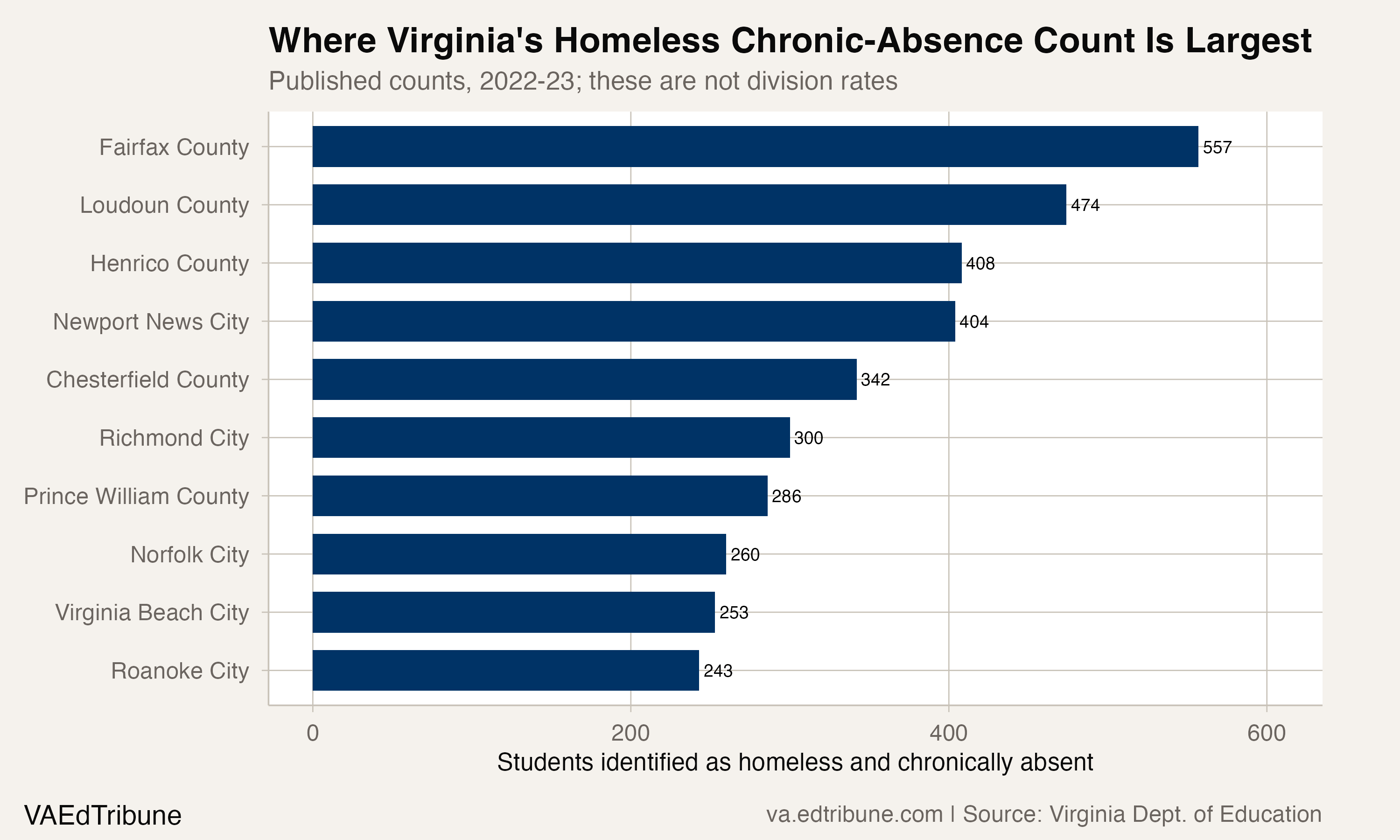
The 100-student cutoff is our choice, to keep a handful of absences from swinging a division's rate. It changes who leads. At 50 students, Montgomery County moves to the top with a 67.1% rate, for 51 students. Loudoun has the lowest rate at every cutoff we tested.
VDOE suppressed the count for 18 divisions where the number was too small to publish. Those divisions are left out of the comparison rather than estimated.
What the numbers do not say
The state file reports how many students identified as homeless were chronically absent and what share of that group they represent. It does not say why. Divisions also differ in how actively they identify students as homeless under the federal McKinney-Vento Act, which shapes who is counted in the group to begin with.
Correction (October 3, 2026): An earlier version of this article said Virginia's absence file published no chronic absenteeism rate for students identified as homeless and reported 5,429 such students as chronically absent in 2022-23. The state data used earlier built those figures by adding up school and division rows and counted cells VDOE suppresses for privacy as zero, which understated every count, and it did not carry VDOE's published rates. VDOE's own statewide file reports 7,687 students and a rate of 49.1%. The headline, the statewide and division figures, and the charts have been corrected. A section that compared division counts with a separate enrollment file was removed because it rested on the understated counts. A version before that one reported a 60.3% rate built from the same undercount and a homeless enrollment figure from a different file; that rate was also wrong.
Detailed code that reproduces the analysis and figures in this article is available exclusively to EdTribune subscribers.
Discussion
Sign in to join the discussion.
Loading comments...