In 2014, white students dropped below half of Virginia's public school enrollment for the first time. Eleven years later, white students make up 43.4% of the state's 1,261,501 public school students, a share that has never recovered and shows no sign of leveling off.
The number behind the percentage is more concrete. Virginia has lost 106,226 white students since 2011, a 16.3% decline, even as total enrollment grew slightly over the same period. From their peak of 722,300 in 2004, white students have declined by 175,408, a loss larger than the entire enrollment of Prince William County.
The descent, by the numbers
White enrollment in Virginia has followed a remarkably steady downward slope. The share dropped from 61.4% in 2003 to 52.1% in 2011, crossed below 50% at 49.9% in 2014, and has never recovered. A brief uptick in 2017, likely a data methodology adjustment, proved temporary. By 2025, white students stood at 43.4%, nearly 18 percentage points below where they were two decades ago.
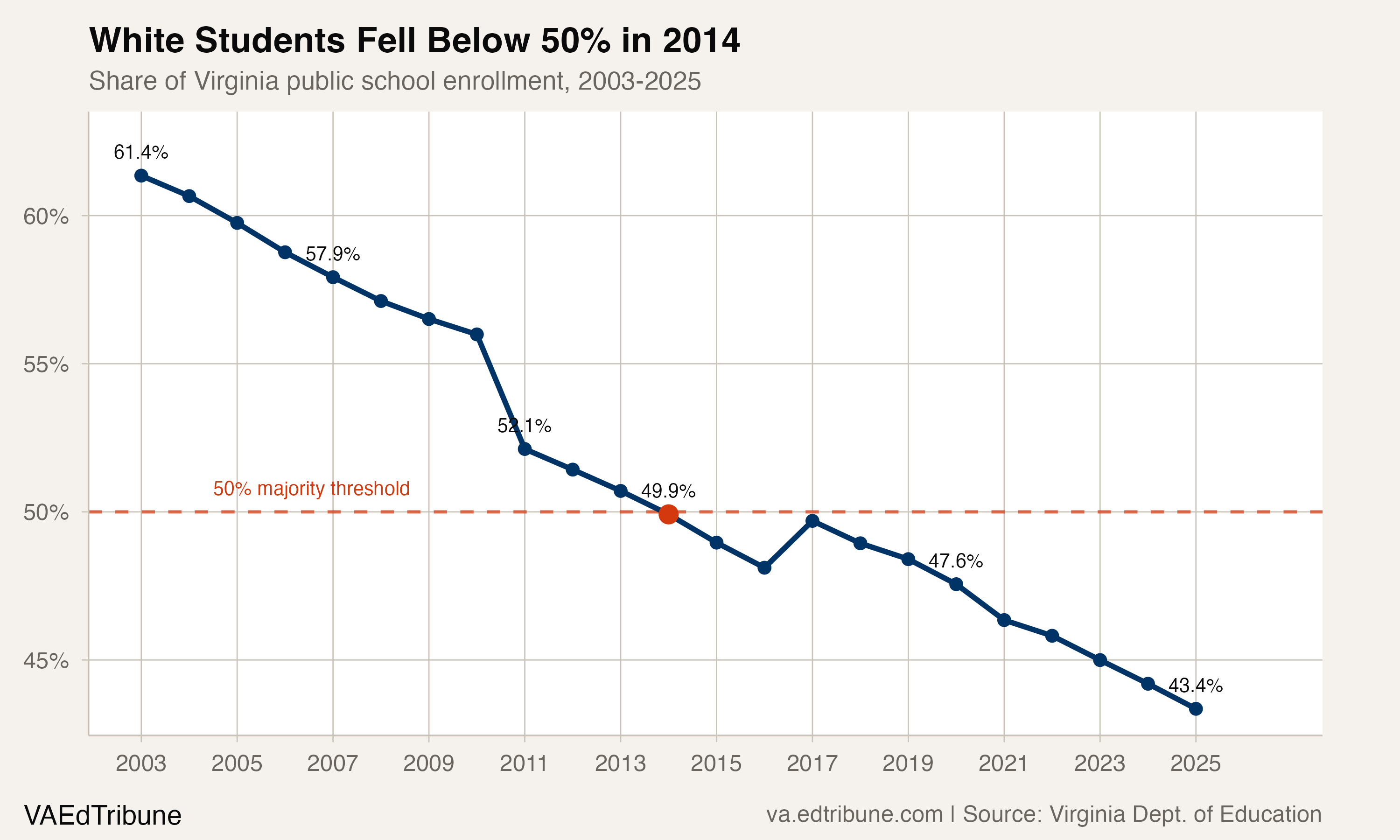
The rate of decline has been roughly one percentage point per year since 2020, accelerating from the 0.6 to 0.8 points per year that characterized the 2011-2019 period. White enrollment fell by 10,934 students in 2025 alone. The question is not whether the share will continue falling but how far it goes before stabilizing.
By comparison, Virginia's general population remains 58.4% white, a 15 percentage-point gap between the adult population and the public school student body. Public schools are a leading indicator: the demographic composition of Virginia's classrooms in 2025-26 will be the composition of its workforce in 20 years.
Who replaced whom
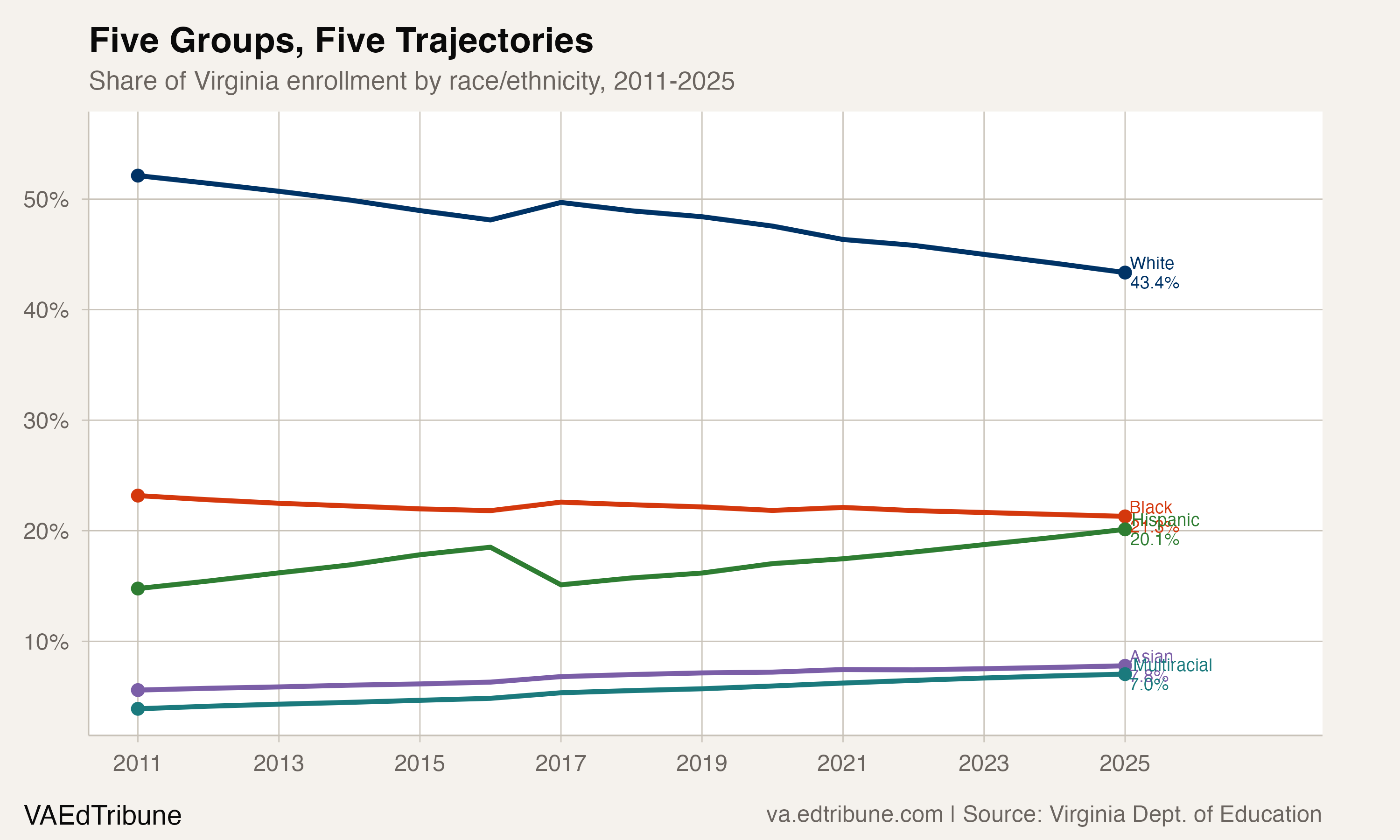
The 8.8 percentage-point drop in white share since 2011 did not flow evenly to other groups. Hispanic students absorbed the largest share of the shift, gaining 5.4 percentage points to reach 20.1%, a milestone the group crossed for the first time in 2025. Multiracial students gained 3.1 points (to 7.0%), and Asian students gained 2.2 points (to 7.8%). Black enrollment, the second-largest group, actually lost 1.9 points, falling to 21.3%.
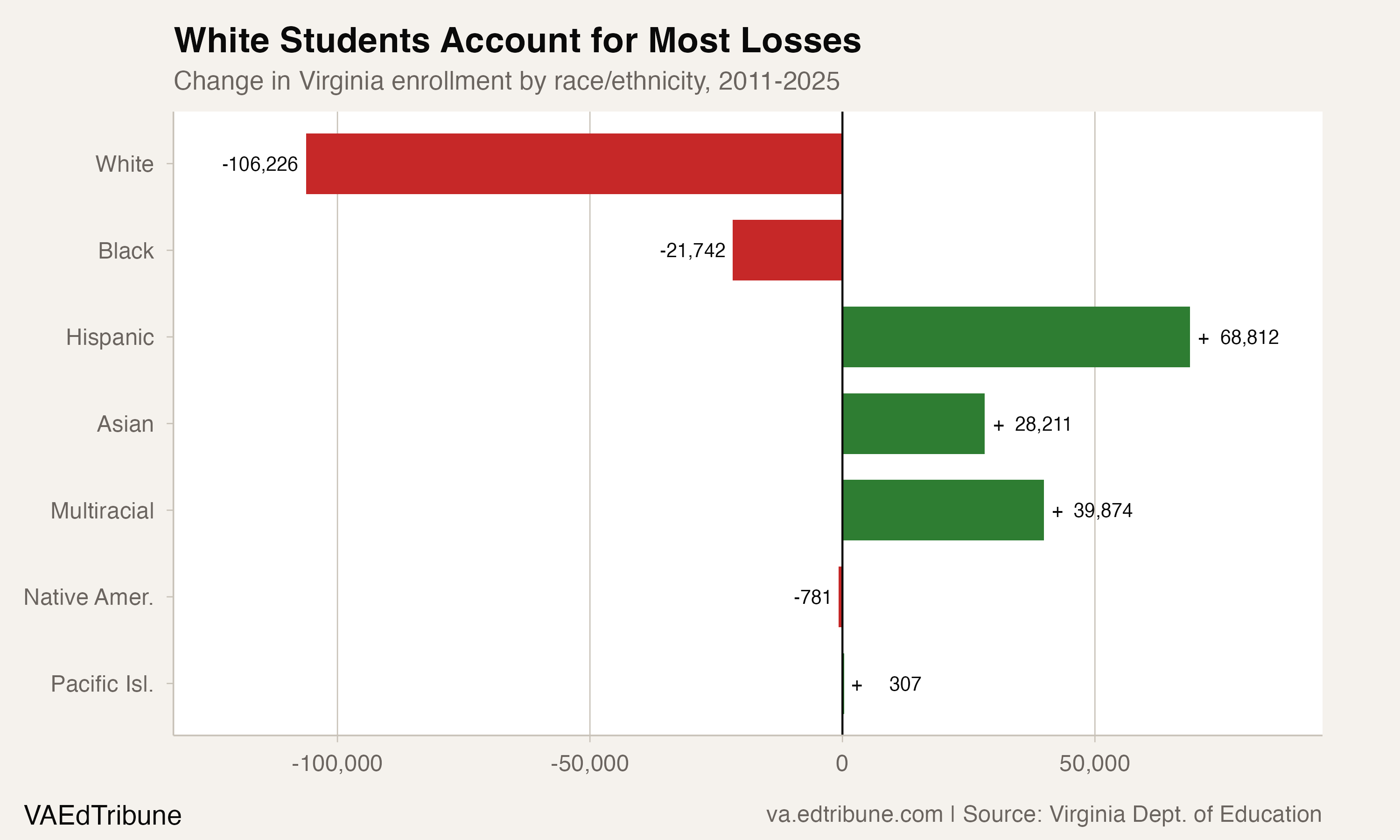
In absolute terms, the scale is lopsided. White students lost 106,226 while Hispanic students gained 68,812, Asian students gained 28,211, and multiracial students gained 39,874. Black students lost 21,742. Virginia's schools did not simply swap one majority for another. They became a place where no single group dominates.
The Hispanic-Black convergence
One of the most consequential shifts is happening between Virginia's second and third-largest student groups. In 2011, Black enrollment exceeded Hispanic enrollment by 105,348 students, a gap so wide it seemed permanent. By 2025, that gap had narrowed to 14,794 — Black students at 268,670, Hispanic students at 253,876.
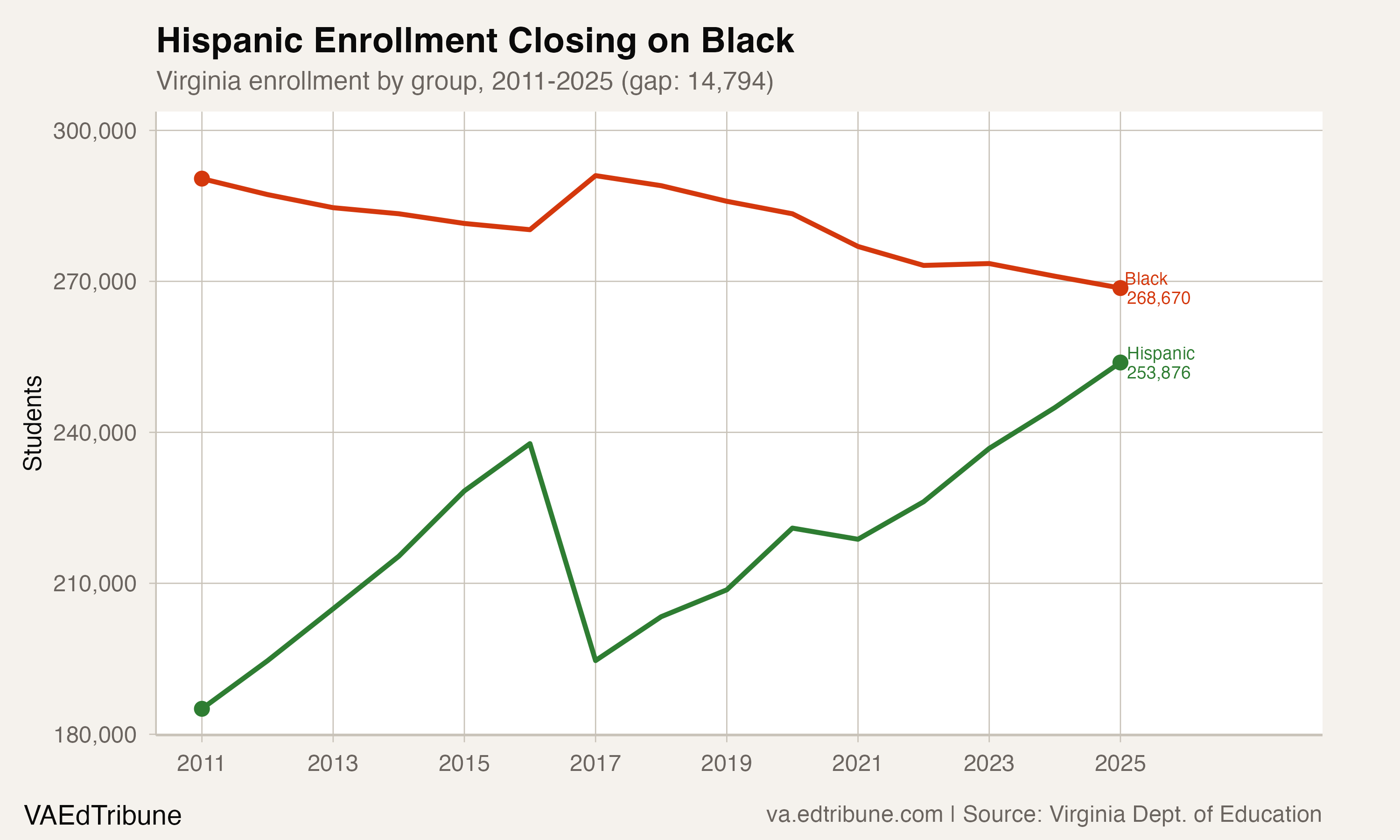
At the current rate of convergence, roughly 11,000 students per year, Hispanic enrollment will overtake Black enrollment by approximately 2027 or 2028. That would make Hispanic students the second-largest group in Virginia's schools for the first time.
The implications are practical. Title III funding for English learner services follows language demographics. School divisions that built staffing models around Black-white student bodies are now managing three large groups with distinct service needs. Manassas Park City↗ET, where Hispanic enrollment rose from 47.2% to 70.7% since 2011 and white enrollment fell from 29.9% to 9.8%, represents the far end of this transformation.
Thirteen divisions crossed the line
Virginia became majority-minority statewide in 2014, but the shift has rippled outward since then. Thirteen additional school divisions, communities where white students were the clear majority in 2011, have since flipped.
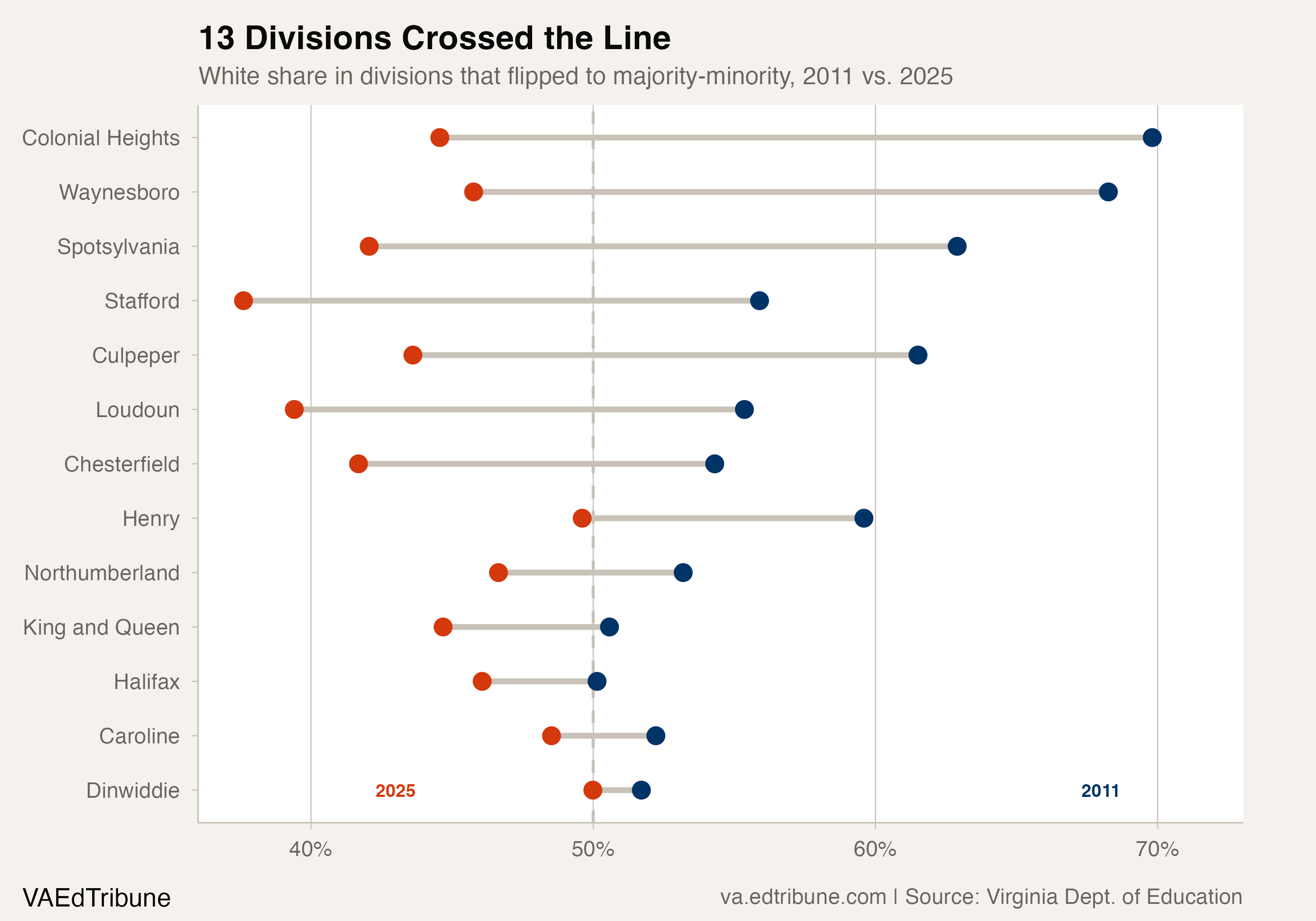
The most dramatic transformation was in Colonial Heights↗ET, a small independent city south of Richmond. White students made up 69.8% of enrollment in 2011. By 2025, they were 44.6%, a 25.2 percentage-point drop. Waynesboro↗ET, in the Shenandoah Valley, followed a similar arc: 68.3% to 45.8%.
But the divisions with the largest fiscal implications are the suburban giants. Loudoun County↗ET went from 55.4% white to 39.4%. Stafford County↗ET fell from 55.9% to 37.6%. Chesterfield County↗ET dropped from 54.3% to 41.7%. Spotsylvania County↗ET fell the furthest among large divisions, from 62.9% to 42.1%, a 20.8-point swing.
In total, 54 of Virginia's 131 school divisions, 41.2%, are now majority-minority. That proportion has grown steadily and shows no sign of plateauing.
A 94-point gap across the state
Craig County, in the Allegheny Mountains, is 98.4% white. Petersburg, 180 miles east, is 4.1% white. That 94-point gap means staffing, curriculum, and language-service needs vary enormously by region.
The 10 whitest divisions are all in Southwest Virginia and the Shenandoah Valley: Craig (98.4%), Russell (97.0%), Buchanan (96.8%), Dickenson (96.7%), Lee (96.5%). The 10 least white are urban and inner-suburban: Petersburg (4.1%), Manassas Park↗ET (9.8%), Richmond (11.5%), Greensville (11.8%), Franklin City (13.1%).
This gap is not narrowing much. Even as places like Harrisonburg↗ET (white share: 44.4% to 27.9%) and Winchester (48.3% to 33.9%) have diversified rapidly, the deep-rural divisions remain essentially unchanged. The demographic transformation is concentrated in the suburban ring and the I-81 corridor.
What is driving the shift
Three forces are compressing white enrollment, each operating on a different timeline.
The most powerful is demographic: white Virginians are having fewer children. Virginia births have declined in 11 of the last 17 years, trailing the 2007 peak by 13.3%. The Weldon Cooper Center at the University of Virginia found that Fairfax County births dropped 15% between 2015 and 2022, and Arlington births fell nearly 25%. Because white families make up a disproportionate share of these affluent jurisdictions, the birth decline hits white enrollment hardest.
The second is school choice. Homeschooling in Virginia reached 66,117 students in 2025-2026, a 49.5% increase since before the pandemic. Before COVID, more than 90% of Virginia-born children enrolled in public kindergarten; by 2023, that share had fallen to roughly 85%. National research has found that the shift to private schooling and homeschooling has been concentrated among higher-income and white families, which means the public school enrollment decline is not racially neutral. Fairfax County↗ET lost 8,975 white students since 2011 (12.2%), even as the county's school-age population grew.
The third is immigration and migration. Hispanic enrollment growth of 68,812 students since 2011 reflects both new arrivals and natural increase within Virginia's growing Latino communities. Harrisonburg↗ET, a Shenandoah Valley city with a large agricultural and poultry processing economy, saw Hispanic enrollment rise from 38.0% to 54.8% of total enrollment. Asian enrollment growth of 28,211 students, concentrated in Northern Virginia, reflects the continued draw of the federal government and technology sector for immigrant professionals.
These three forces interact. Falling white births shrink the numerator. Growing Hispanic and Asian populations expand it. And the disproportionate exit of white families to non-public options accelerates both effects.
Where it goes from here
The Weldon Cooper Center at UVA, the state's most authoritative source on enrollment projections, concluded that "by the fall of 2019, well before the pandemic, the exodus of families from Virginia and a steady decline in births had put Virginia's public schools on course to lose approximately 50,000 students during the 2020s." The pandemic accelerated a trend that was already in motion.
Their latest projections call for 36,827 fewer students statewide by 2030, with Loudoun↗ET, Fairfax↗ET, and Arlington facing declines of 4.7% to 6.6%. Rural localities like Buchanan and Northampton counties face projected losses of 16%. Demographer Hamilton Lombard has called the enrollment decline "a signal of things to come for colleges and the workforce later this decade."
Because white families make up a larger share of the overall population than the student body, continuing birth declines and non-public school exits will push white enrollment share further below its current 43.4%.
Craig County and Petersburg
Those two divisions sit at opposite ends of everything except the funding formula. Both show up in the same state average. Both face enrollment decline. And neither one's challenges resemble the other's.
The state average obscures that reality. But the state average is also where the money comes from. Virginia's funding formula does not adjust for the cost of hiring a bilingual teacher in a market where 3% of the state's teachers are Hispanic despite Hispanic students making up 70% of English learners. Spotsylvania↗ET went from nearly two-thirds white to 42% in 14 years. Its classrooms changed faster than its teacher pipeline did, and faster than the state's funding model was built to handle. The racial composition data is a trailing indicator. The staffing and budget pressures it creates arrived years ago.
Detailed code that reproduces the analysis and figures in this article is available exclusively to EdTribune subscribers.
Discussion
Sign in to join the discussion.
Loading comments...