In Manassas Park↗ET, seven of every 10 students are Hispanic. White enrollment has fallen to 9.8%, down from 19.8% eight years ago. Two hours south in the Shenandoah Valley, Harrisonburg↗ET crossed the majority-Hispanic threshold in the early 2020s and now enrolls more Hispanic students than all other groups combined, at 54.8%.
These divisions are the leading edge, not the outliers. Across Virginia, Hispanic students now account for one in five of the state's 1,261,501 public school students, crossing 20% for the first time in the 2024-25 school year. The milestone is the product of steady, compounding growth: 253,876 Hispanic students, up 59,229 since 2017, an increase of 30.4% during a period when total state enrollment barely moved.
Closing the gap with Black enrollment
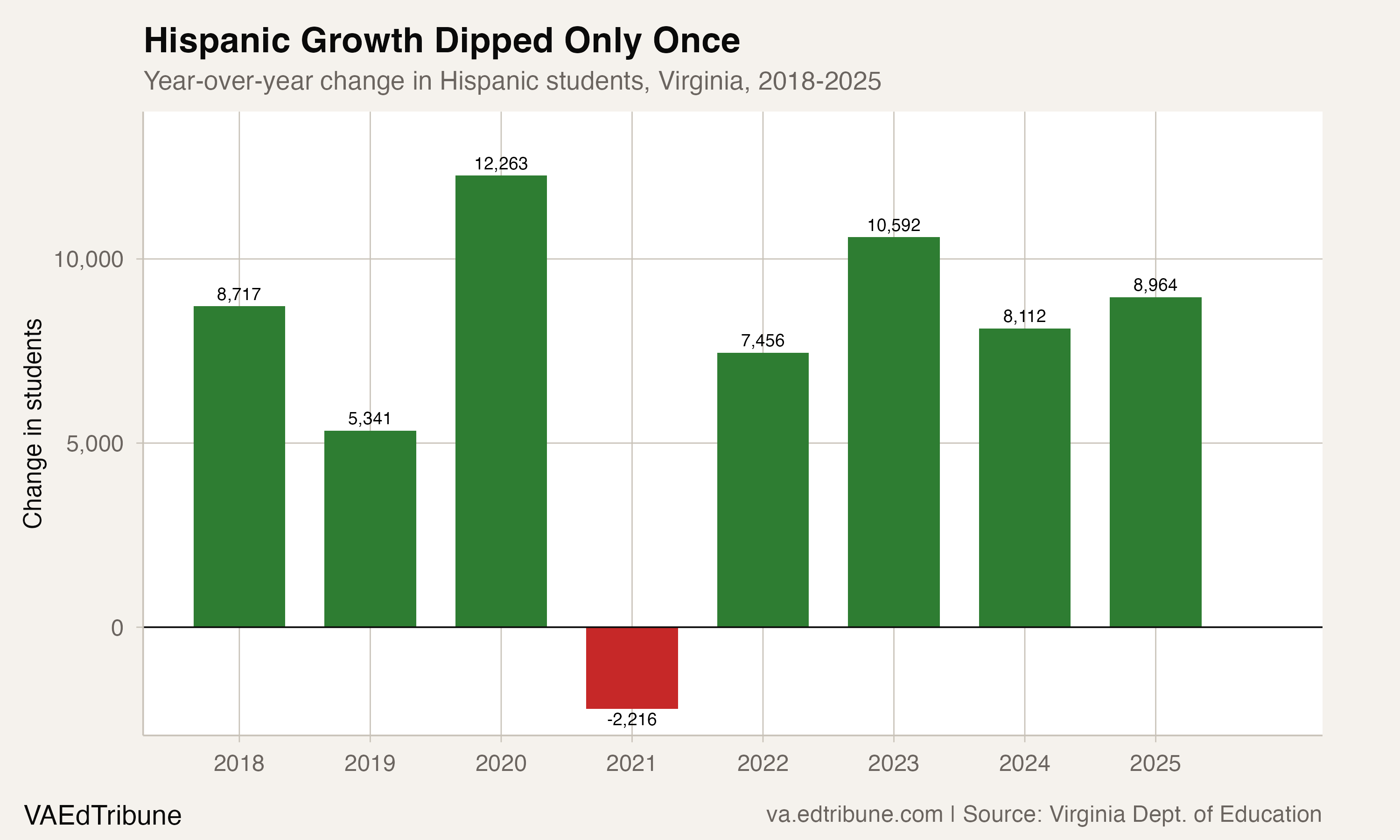
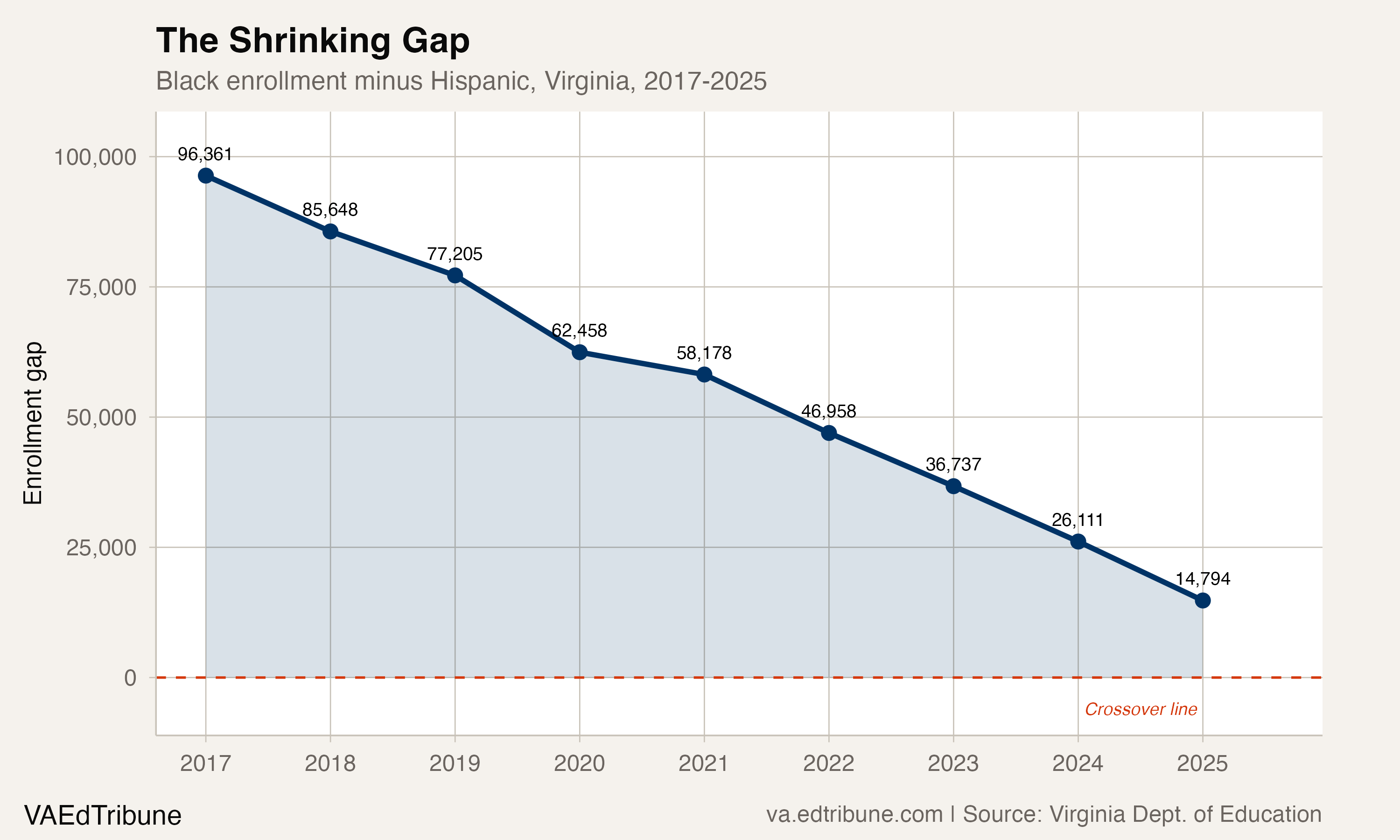
The statewide data tells a convergence story. Hispanic enrollment has grown every year since 2017 except for a single COVID-year dip in 2021. Black enrollment has declined in seven of the eight years since, with only a small 371-student bump in 2023 interrupting the slide. In 2017, 96,361 more Black students than Hispanic students attended Virginia public schools. By 2025, that gap had collapsed to 14,794.
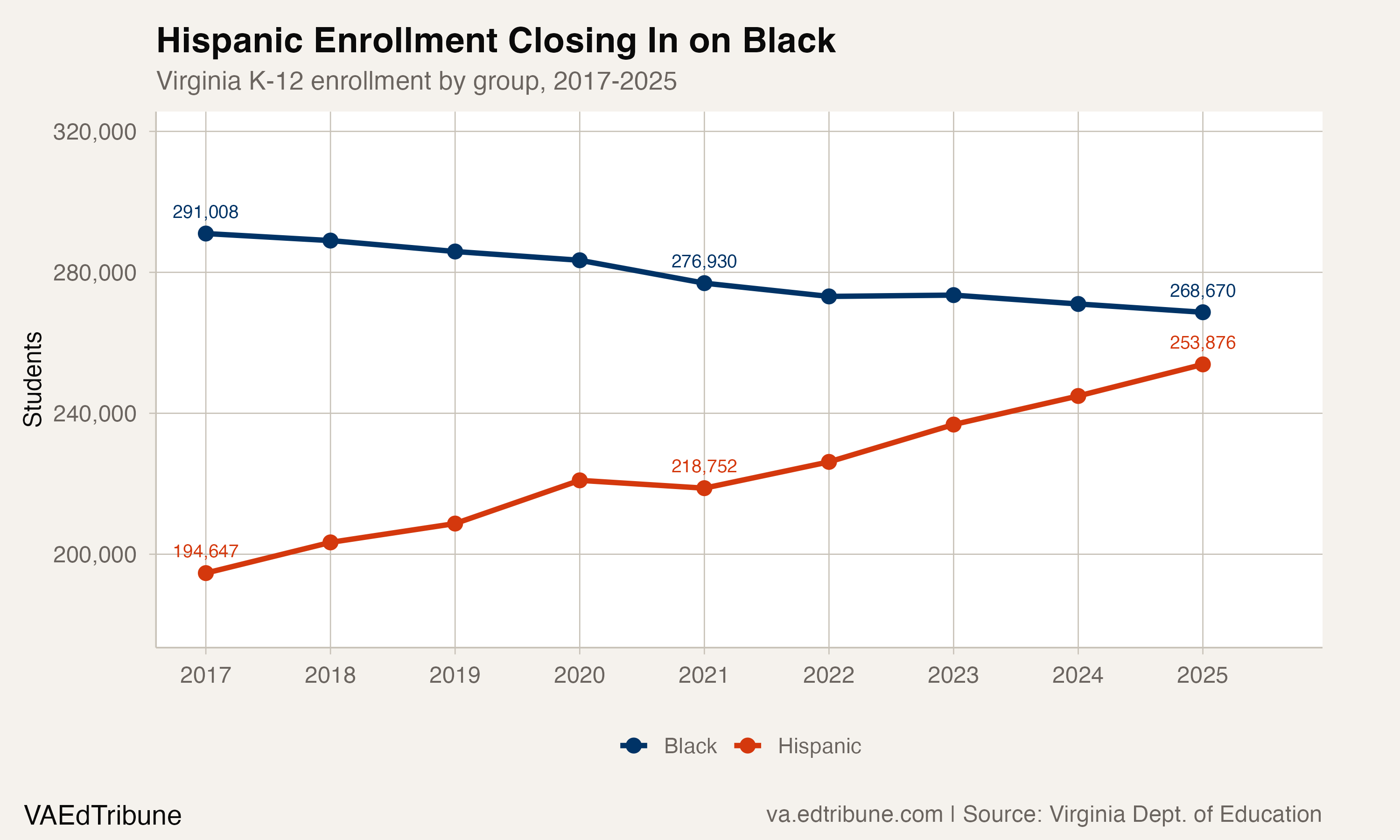
At the current rate of narrowing, roughly 10,200 students per year, Hispanic enrollment will surpass Black enrollment by 2027. If that happens, it will be the first time Hispanic students are the second-largest racial or ethnic group in Virginia's public schools, behind only white students. The shift would also reorder Virginia's claim on federal Title III funding, an $890 million national program that allocates 80% of its grants based on a state's share of English learners.
The convergence is driven from both directions. Hispanic enrollment added 8,964 students in 2025 alone, 3.7% growth on a growing base. Black enrollment lost 2,353, a 0.9% decline continuing a trajectory that has cost the group 22,338 students since 2017.
The share shift underneath
Raw headcounts capture only part of the transformation. In share terms, Hispanic students rose from 15.1% to 20.1% of Virginia enrollment between 2017 and 2025, a gain of five percentage points. Over the same period, white students fell from 49.7% to 43.4%, Black students from 22.6% to 21.3%. Asian and multiracial students each gained about one point.
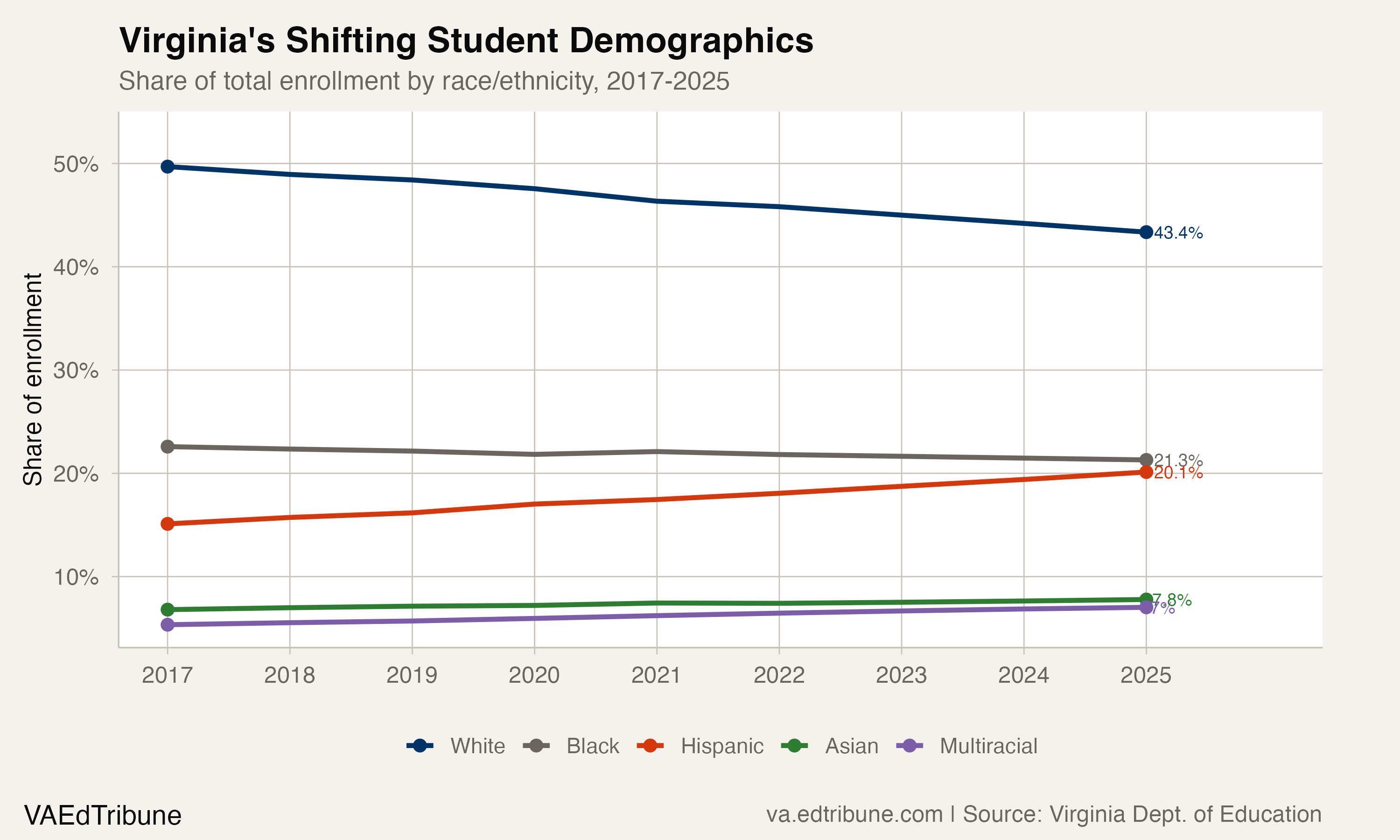
The composition shift is not uniform. Three divisions now enroll more than 50% Hispanic students. Fourteen are above 25%. But 58 of Virginia's 131 divisions, nearly half, still have Hispanic shares above 10%, meaning this is not confined to a handful of gateway communities.
| Division | Hispanic share 2017 | Hispanic share 2025 | Change |
|---|---|---|---|
| Manassas Park | 59.4% | 70.7% | +11.3 pp |
| Manassas City | 62.8% | 70.5% | +7.7 pp |
| Harrisonburg | 45.9% | 54.8% | +8.9 pp |
| Winchester | 35.0% | 45.1% | +10.1 pp |
| Culpeper | 19.6% | 32.8% | +13.2 pp |
| Richmond City | 14.0% | 27.4% | +13.4 pp |
Northern Virginia: the established corridor
The largest absolute numbers sit in Northern Virginia. Fairfax County↗ET alone enrolls 52,672 Hispanic students, 29.2% of the division, up from 25.4% in 2017. Prince William County↗ET has 33,635, or 37.1%. Arlington↗ET is at 31.1%.
But the fastest growth is no longer in these established corridors. Chesterfield County↗ET, in the Richmond suburbs, added 5,775 Hispanic students since 2017, the largest absolute gain of any division. Roanoke City↗ET doubled its Hispanic enrollment from 1,569 to 3,152 over the same period, a 101% increase. Culpeper↗ET jumped from 19.6% to 32.8% Hispanic.
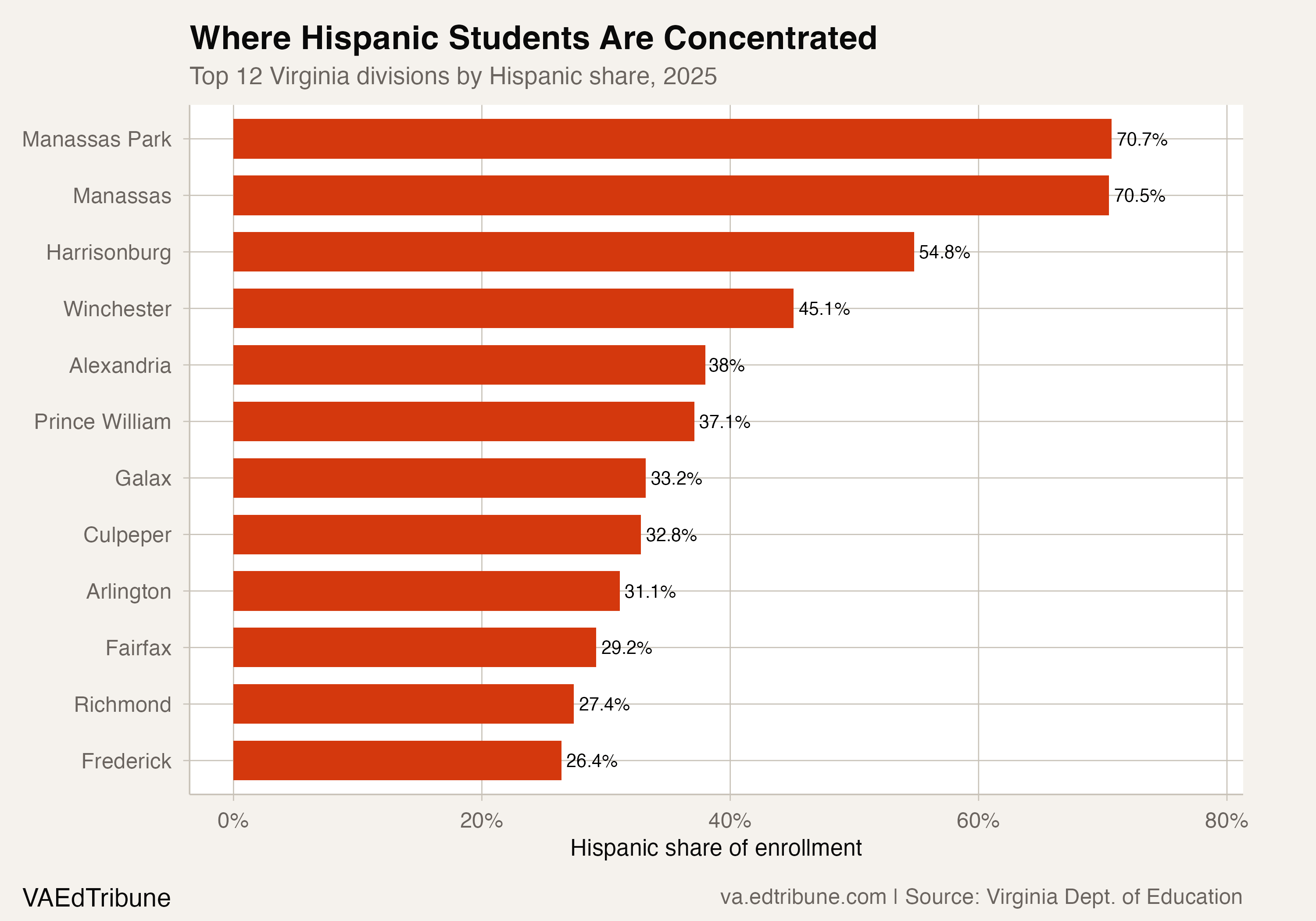
The geographic spread matters for staffing. When Hispanic enrollment growth was concentrated in Northern Virginia, the bilingual teacher pipeline could be focused regionally. Now divisions across the Richmond metro, the Shenandoah Valley, and Southwest Virginia need the same instructional capacity.
What is driving this
The most likely driver is immigration. Cardinal News reported that immigration accounted for 73.3% of Virginia's total population growth in the year ending July 2024, up from just 12.3% in 2020. Net immigration to Virginia surged from 766 in 2020 to 56,155 in 2024.
Virginia's Hispanic population has deep roots in a specific migration pattern. Over half of the state's Latino residents are of Salvadoran, Mexican, or Puerto Rican heritage, according to Encyclopedia Virginia. The Central American wave, which began in the 1980s during El Salvador's civil war, became the longest-sustained immigration flow in the commonwealth's history. Manassas Park and Manassas City↗ET, where Hispanic enrollment exceeds 70%, have some of the highest concentrations of Salvadoran-origin residents among U.S. cities.
Harrisonburg's growth follows a different path. The Shenandoah Valley's poultry industry has drawn immigrant workers for decades. The division enrolls students from 76 birth countries speaking 63 languages, with Spanish as the predominant home language for nearly half of families.
A competing explanation is reclassification: some of the measured growth could reflect improved identification of Hispanic students already in the system rather than new arrivals. The data cannot distinguish between a student who arrived from El Salvador last year and a student whose family has been in Virginia for a generation but was previously categorized differently. The sustained, steady nature of the growth, averaging 7,400 additional Hispanic students per year since 2017, suggests real demographic change rather than a one-time reporting shift.
The operational squeeze
The enrollment numbers carry concrete staffing and funding implications. Virginia had more than 3,200 unfilled teaching positions in the 2024-25 school year. Nationally, roughly one in four English learner seats lacks a certified teacher. Virginia's English learner enrollment, which overlaps heavily but not entirely with Hispanic enrollment, grew 8.5% in just two years, from 172,900 in 2023 to 187,586 in 2025.
Roanoke City illustrates the pressure. The division's English learner population now stands at 18.3% of enrollment, with EL counts growing from 2,057 students in 2023 to 2,534 in 2025, an increase of more than 23% in two years. Elizabeth Schenkel, Roanoke's English learner supervisor, told Education Week about the federal Title III funding delays that compound the challenge:
"I cannot proceed with hiring or renewing a contract without knowing when I'm going to have the funds."
The Trump administration proposed eliminating Title III and briefly withheld FY2025 funds in July 2025, but those funds were released and Congress later funded Title III at $890 million for FY2026. For Virginia divisions where Hispanic enrollment is growing fastest, the episode showed how exposed bilingual instruction remains when federal funding is delayed or targeted for elimination.
The division-level flip
Hispanic students now outnumber Black students in 50 of Virginia's 131 divisions, up from 38 in 2017. The largest margins are in Northern Virginia, where Fairfax↗ET has 35,119 more Hispanic than Black students and Prince William↗ET has 16,670 more. But the flip is happening in places like Alexandria↗ET (margin: 2,411), Culpeper↗ET (1,707), and Richmond City↗ET, where Hispanic enrollment nearly doubled from 3,472 to 5,865 in eight years, while Black enrollment fell from 17,685 to 12,162.
The statewide crossover, when it comes, will not be a single event. It will be the accumulation of dozens of division-level crossovers that have already happened or are happening now. Fifty divisions have already flipped. In Culpeper, Hispanic enrollment jumped from one in five students to one in three in eight years. The division's Title III coordinator position did not exist five years ago. Whether the staffing, infrastructure, and instructional programs needed for a 20%-and-climbing student body will scale at the same rate as the enrollment shift itself is not a question anyone in Richmond or Harrisonburg or Roanoke has time to debate in the abstract. They are hiring, or trying to.
Detailed code that reproduces the analysis and figures in this article is available exclusively to EdTribune subscribers.
Discussion
Sign in to join the discussion.
Loading comments...