Manassas City↗ET enrolls 7,663 students. More than half of them, 4,005, are classified as English learners. In Manassas Park↗ET, the number is 50.7%. These are not large urban school systems absorbing a national wave. They are small Northern Virginia cities, population 40,000 and 17,000 respectively, where the majority of public school students are now learning English as a second language.
Statewide, Virginia added 14,686 English learners between 2023 and 2025, an 8.5% increase, while total enrollment fell by 1,947. One in 6.7 Virginia students is now classified as limited English proficient. The growth is accelerating: 5,061 new EL students appeared in 2024, then 9,625 more in 2025.
The fastest-growing student group in a shrinking system
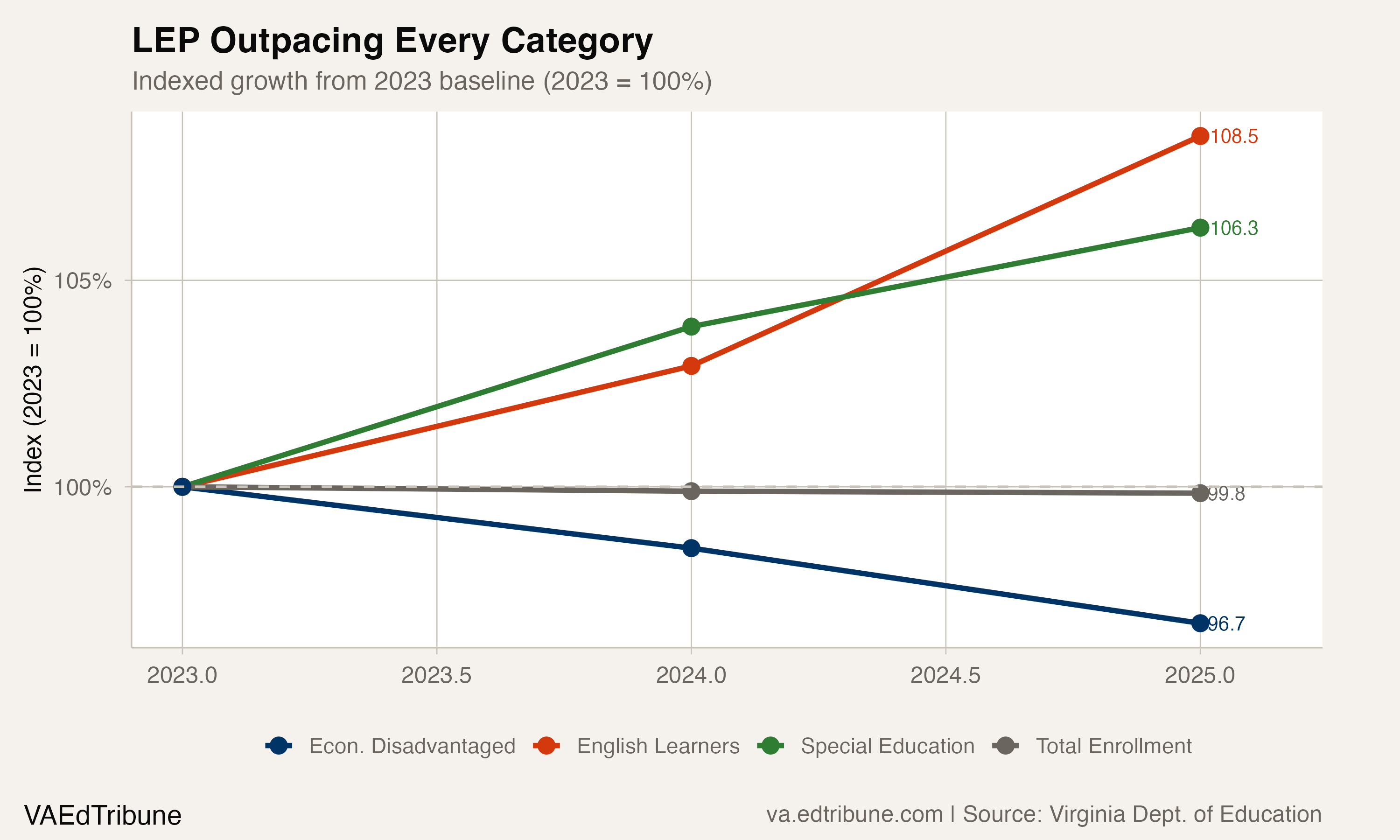
English learners grew faster than any other student category tracked by the Virginia Department of Education over the past two years. Special education enrollment rose 6.3% over the same period. The number of students classified as economically disadvantaged fell 3.3%. Total enrollment barely moved. LEP enrollment outpaced them all at 8.5%.
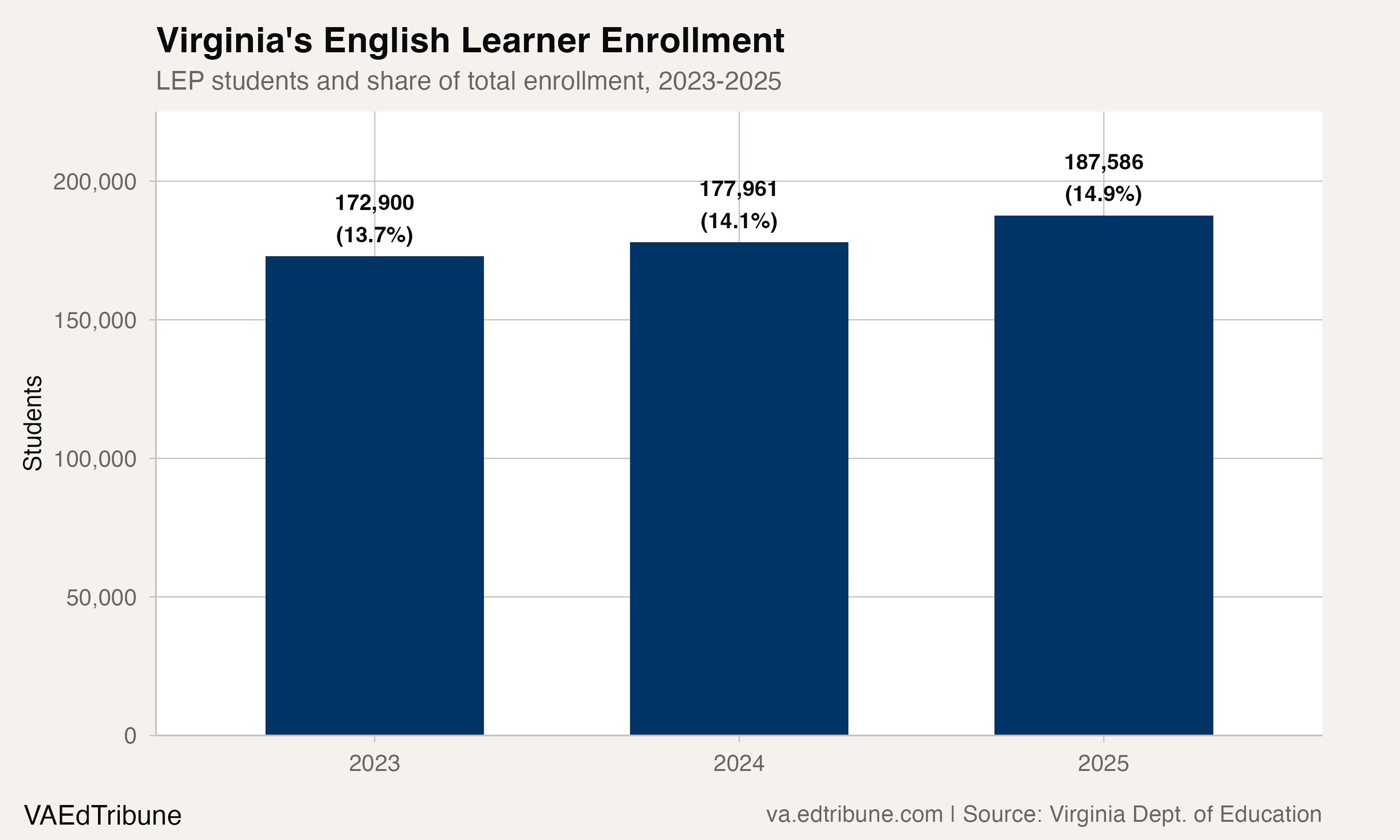
The share of Virginia's student body classified as English learners climbed from 13.7% in 2023 to 14.9% in 2025, a 1.2 percentage-point shift in two years. That translates to roughly one additional English learner for every eight students statewide.
This is not a Northern Virginia story alone. LEP enrollment grew in 112 of 128 divisions with comparable data across both years. Only 14 divisions saw a decline. The geographic spread is striking: Roanoke↗ET, 230 miles southwest of Washington, saw its LEP rate jump from 15.0% to 18.3% in two years, adding 477 English learners. Fredericksburg↗ET, a small city between Richmond and D.C., had the fastest rate increase of any division: its LEP share climbed 5.3 percentage points to 26.4%.
Where the growth is concentrated
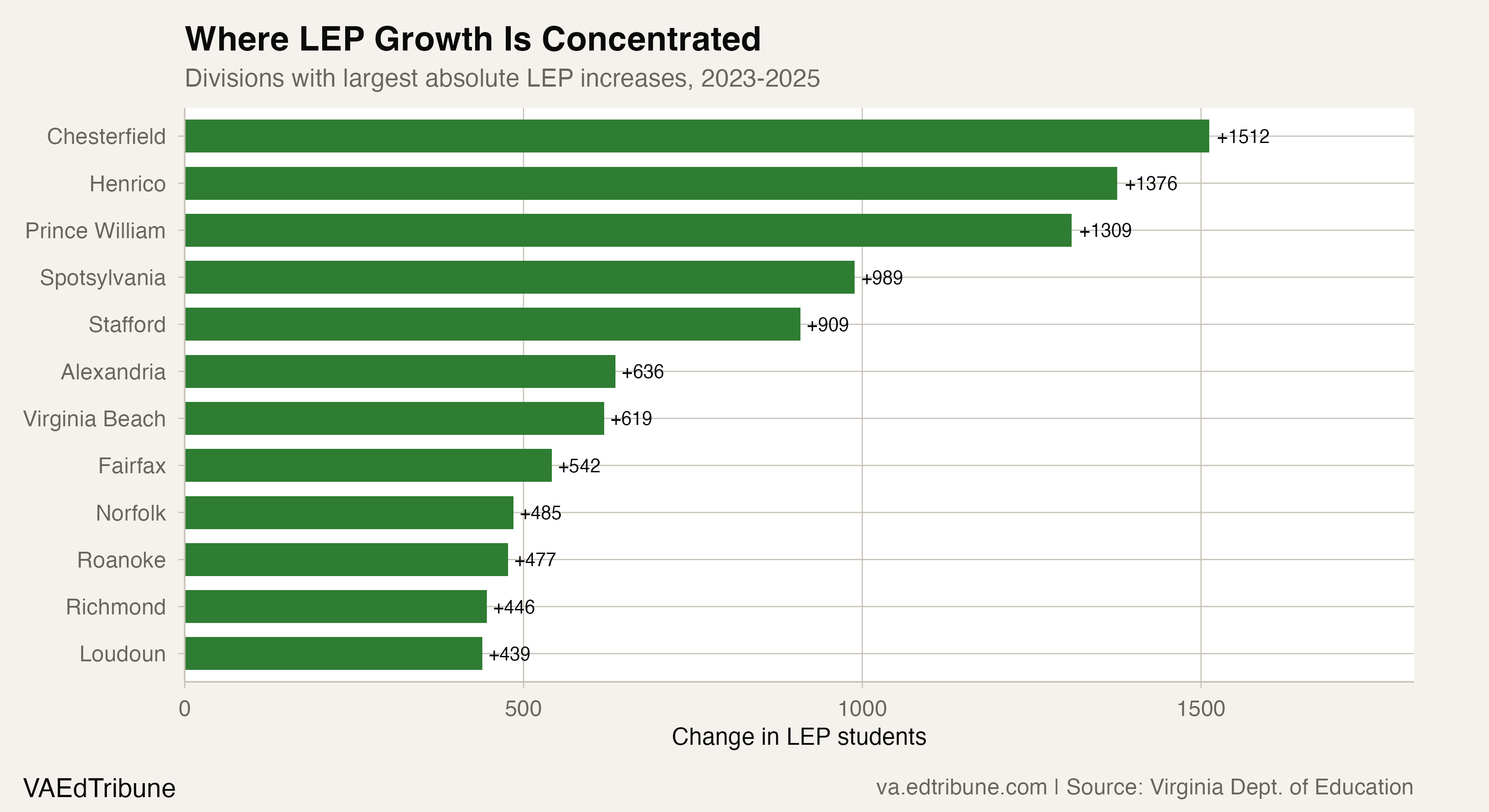
In absolute numbers, the largest gains came from suburban divisions ringing Washington and Richmond. Chesterfield County↗ET added the most EL students of any division, 1,512, pushing its LEP rate from 14.1% to 16.4%. Henrico County↗ET added 1,376, a 23.0% increase. Prince William County↗ET added 1,309, bringing its LEP share to 28.5%, or more than one in four students.
But the divisions with the highest LEP concentrations are smaller. Nine Virginia divisions now have English learner rates above 25%. The top four all exceed 40%:
| Division | LEP Students | LEP Rate | Change from 2023 |
|---|---|---|---|
| Manassas City | 4,005 | 52.3% | +62 |
| Manassas Park | 1,720 | 50.7% | +20 |
| Alexandria | 7,476 | 45.0% | +636 |
| Harrisonburg | 3,013 | 44.1% | +201 |
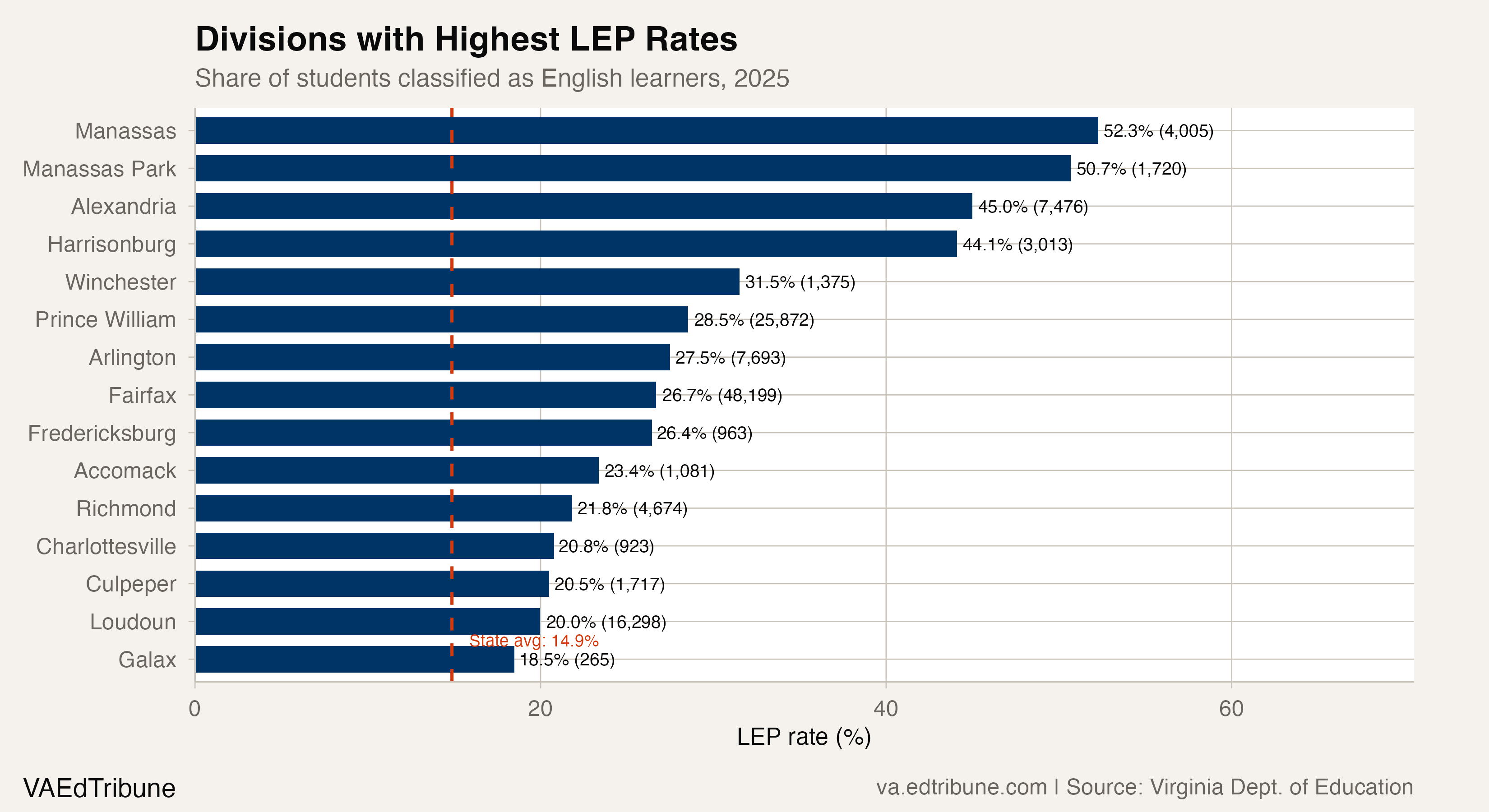
Alexandria↗ET and Harrisonburg↗ET are approaching the majority-LEP threshold. At current rates, both could cross 50% within the next several years. Manassas City and Manassas Park already did.
Two mechanisms, one pattern
Two forces drive English learner counts: new students arriving who speak a language other than English, and existing students being identified as needing language services. Virginia's data does not distinguish between the two, which means the 8.5% statewide increase could reflect immigration, improved identification, or both.
The immigration explanation has substantial support. Virginia's population grew by 76,439 people in the year ending July 2024, and 73.3% of that growth, 56,155 people, came from international immigration. Manassas City and Manassas Park are gateway communities where immigrant families concentrate. The Northern Virginia Regional Commission reports that immigrants make up 28% of Northern Virginia's population, with Fairfax County's foreign-born share reaching 30.9% in 2024. The school enrollment numbers track that demographic reality.
The identification explanation cannot be ruled out. Virginia uses a WIDA ACCESS composite score of 4.4 as the threshold for reclassifying English learners as proficient, a single test-based criterion. Any change in how aggressively divisions screen incoming students, or how many students clear the reclassification bar each year, shifts the LEP count without a single new family moving to Virginia. The statewide data does not publish entry and exit rates separately, so the relative contribution of each mechanism remains unknown.
What the data does show: approximately 74% of Virginia's English learners are Hispanic, consistent with statewide reporting that puts the figure at about 70% for the 2024-25 school year. LEP and Hispanic enrollment are not the same category, but they overlap substantially. Hispanic enrollment grew by 17,076 over this period, larger than the 14,686 LEP gain, suggesting much of the new English learner population comes from Spanish-speaking families.
A funding model designed for a different era
Virginia's state funding formula allocates one ESOL teacher position for every 50 English learner students. A 2022 Commonwealth Institute analysis found that this ratio produces a per-student supplement of roughly $725, or 13.5% above base funding. That is less than half the national average supplement of 39% and falls well below benchmarks from independent adequacy studies in other states, which recommend supplements of 35% to 41%.
"Virginia underfunds English language learners compared to other states... providing $725 per EL student, a 13.5% supplement above base funding, compared to a national average supplement of 39%." -- The Commonwealth Institute, 2022
At the current 50-to-1 ratio, 187,586 LEP students generate roughly 3,752 state-funded ESOL teacher positions. Whether divisions can actually fill those positions is another question. Only 3% of Virginia teachers identify as Hispanic despite Hispanic students making up 70% of the English learner population. The mismatch between student language needs and the bilingual teacher supply is widening as EL enrollment accelerates.
The federal funding picture is unstable. During the 2025 Title III funding delay, Roanoke's English-learner supervisor Elizabeth Schenkel told Education Week: "I cannot proceed with hiring or renewing a contract without knowing when I'm going to have the funds." Congress later funded Title III at $890 million for FY2026, but the delay and proposed elimination showed how exposed local EL staffing plans remain. Roanoke's EL population doubled from about 9% to 18% in the last five years.
Growth is spreading beyond the gateway cities
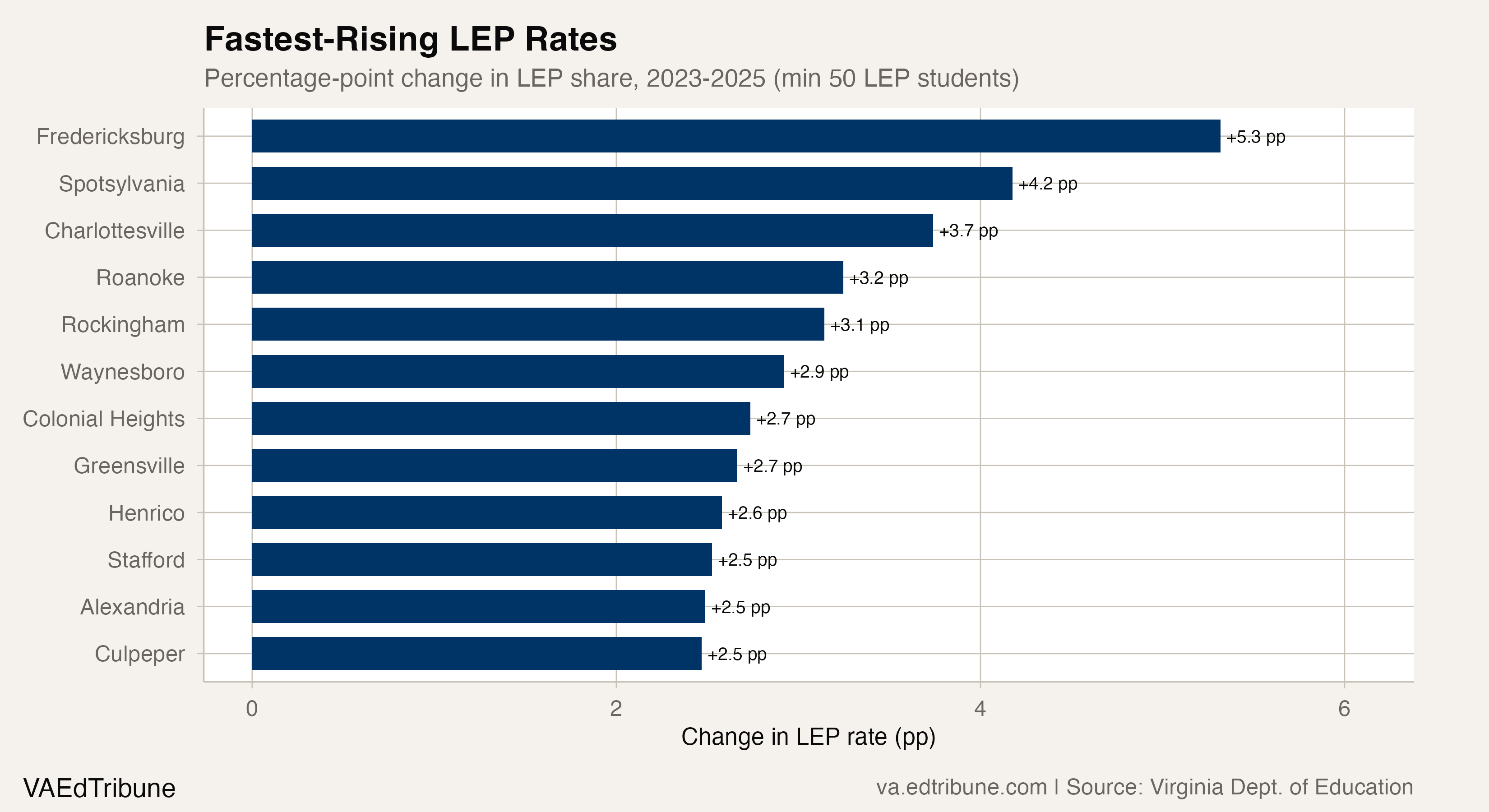
The geographic pattern of LEP growth is shifting. Northern Virginia still holds 60.2% of the state's English learners, down from 64.0% two years ago. The fastest rate increases are now in places like Spotsylvania↗ET (+4.2 percentage points to 14.5%), Charlottesville (+3.7 points to 20.8%), and Waynesboro (+2.9 points to 12.5%). Stafford County↗ET, on the southern edge of the D.C. commuter belt, added 909 EL students, a 24.0% increase.
Even Fairfax County, with the largest English learner population of any Virginia division at 48,199 students, saw relatively modest growth: a 1.1% increase, or 542 students. The EL population in Fairfax is so large that it would rank as the seventh-largest school division in Virginia if it were its own district, larger than Chesapeake or Stafford. Loudoun County↗ET added only 439 EL students (2.8%), and Arlington↗ET actually lost 1,012, an 11.6% decline that stands out as the sharpest drop among NoVA divisions.
Arlington's decline is worth noting because it cuts against the statewide trend. One possible explanation: Arlington's high cost of living is pushing immigrant families to more affordable communities in Prince William, Stafford, and Spotsylvania, where LEP growth has been strongest. Another is that Arlington may be reclassifying English learners as proficient at a faster rate. The data cannot distinguish between the two.
7,300 per year, $725 per student
Virginia added roughly 7,300 English learners per year over the past two years. The state funds their instruction at $725 per student above base, or 13.5% -- less than half the national average supplement of 39%. Closing the gap to lower-bound adequacy would cost $132 million to $169 million annually.
Virginia ranks sixth worst nationally for EL graduation rates and third worst on 8th-grade NAEP reading scores for English learners. In Manassas City, the majority of students are already English learners. In Roanoke, the 2025 Title III delay left district officials unsure whether they could proceed with hiring. In Fredericksburg, one in four students needs language services in a division that did not have an ESOL program at that scale five years ago. The funding formula was designed for a state where English learners were concentrated in a few Northern Virginia suburbs. That state no longer exists.
Detailed code that reproduces the analysis and figures in this article is available exclusively to EdTribune subscribers.
Discussion
Sign in to join the discussion.
Loading comments...