Fairfax County Public Schools↗ET enrolled 188,930 students in 2019-20, the culmination of 17 years of nearly unbroken growth. Five years later, the division enrolled 180,559, a loss of 8,371 students, or 4.4%.
In most of Virginia, that kind of decline has a straightforward explanation: families are leaving. In Fairfax, the school-age population actually grew by roughly 9,000 over the same period. The children are still there. They just stopped showing up.
Seventeen years of growth, erased in five
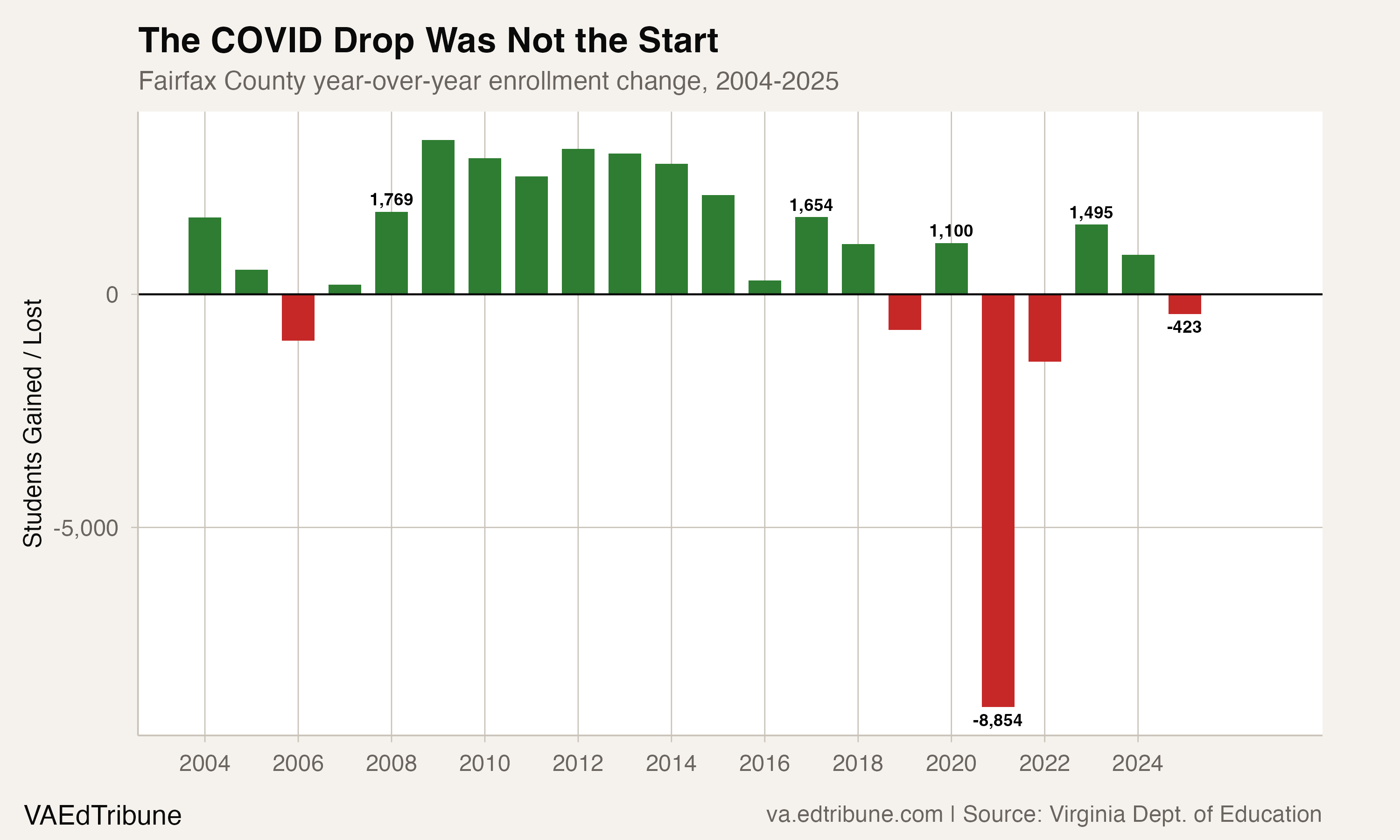
From 2002-03 through 2019-20, Fairfax added 26,345 students, growing from 162,585 to 188,930, a 16.2% increase that tracked the county's expansion as a bedroom community of the federal workforce. Growth peaked in the late 2000s and early 2010s, when the division was adding 3,000 or more students a year. By 2016, that pace had stalled: the division added just 293 students. Growth partially rebounded in 2017 and 2018, but Fairfax recorded its first outright decline in 13 years in 2018-19, losing 761 students.
Then COVID erased all of it. In 2020-21, Fairfax lost 8,854 students in a single year, a 4.7% drop that was among the steepest for any large division in Virginia. What followed was not recovery but stabilization: enrollment crept up by 1,495 in 2022-23 and 852 in 2023-24, then slipped again by 423 in 2024-25.
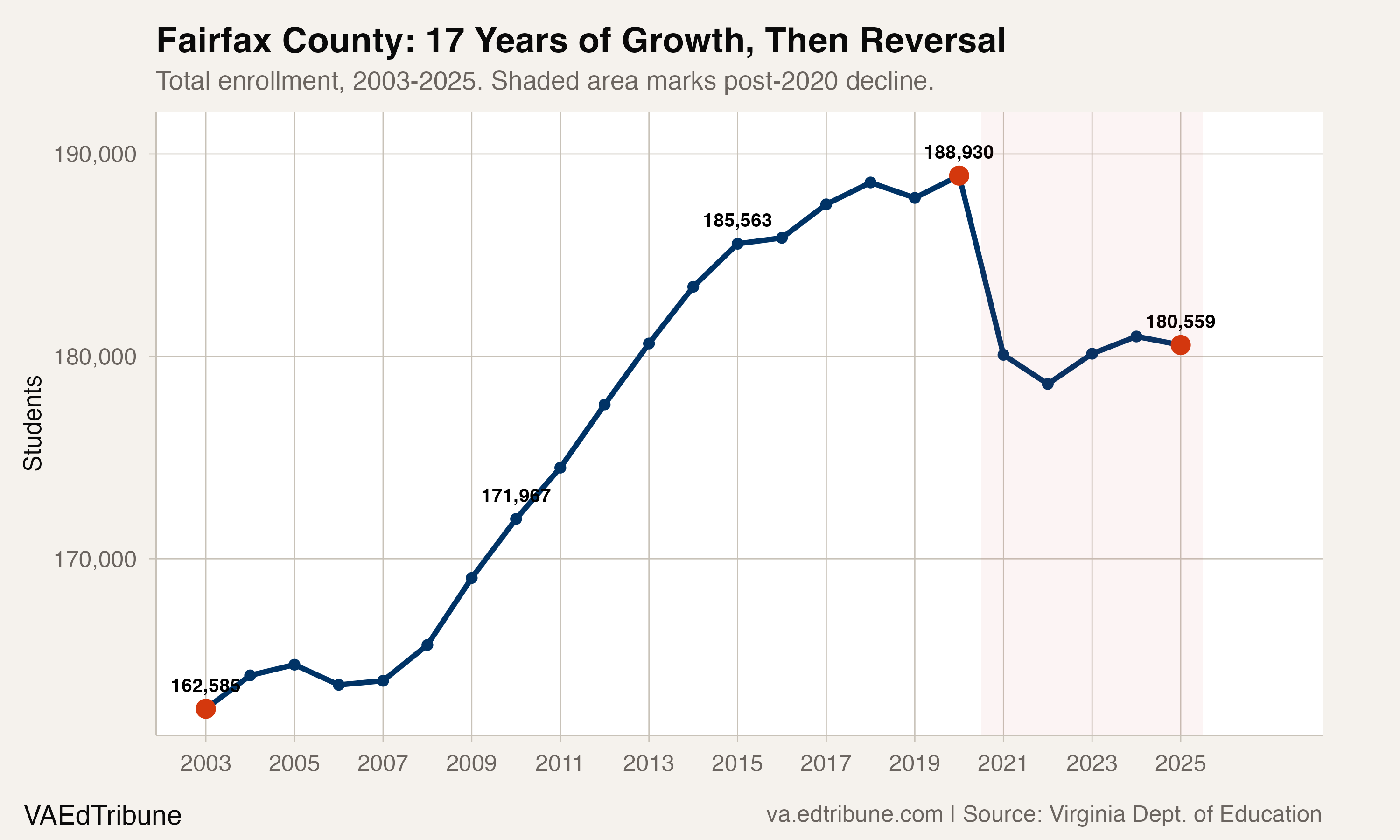
The net result: Fairfax bottomed out at 178,635 in 2021-22 and has since recovered just 1,924 students, or 18.7% of the 10,295-student gap between its peak and trough. That recovery rate nearly mirrors the state's anemic 19.7%.
The elementary collapse that high school masks
The division-wide number understates the problem's severity because it blends two opposite trends. Elementary grades (kindergarten through fifth) lost 5,951 students between 2019-20 and 2024-25, a 7.3% decline. High school enrollment was essentially flat over the same period. It lost just 23 students.
Kindergarten tells the starkest version of the story. Fairfax enrolled 13,070 kindergartners in 2019-20. In 2024-25, that figure was 11,423, a 12.6% drop. Twelfth-grade enrollment, meanwhile, climbed from 14,654 to 15,326. The kindergarten-to-12th-grade ratio (the simplest pipeline indicator) fell to 74.5 in 2024-25, meaning Fairfax enrolled about 3,900 more seniors that year than kindergartners.
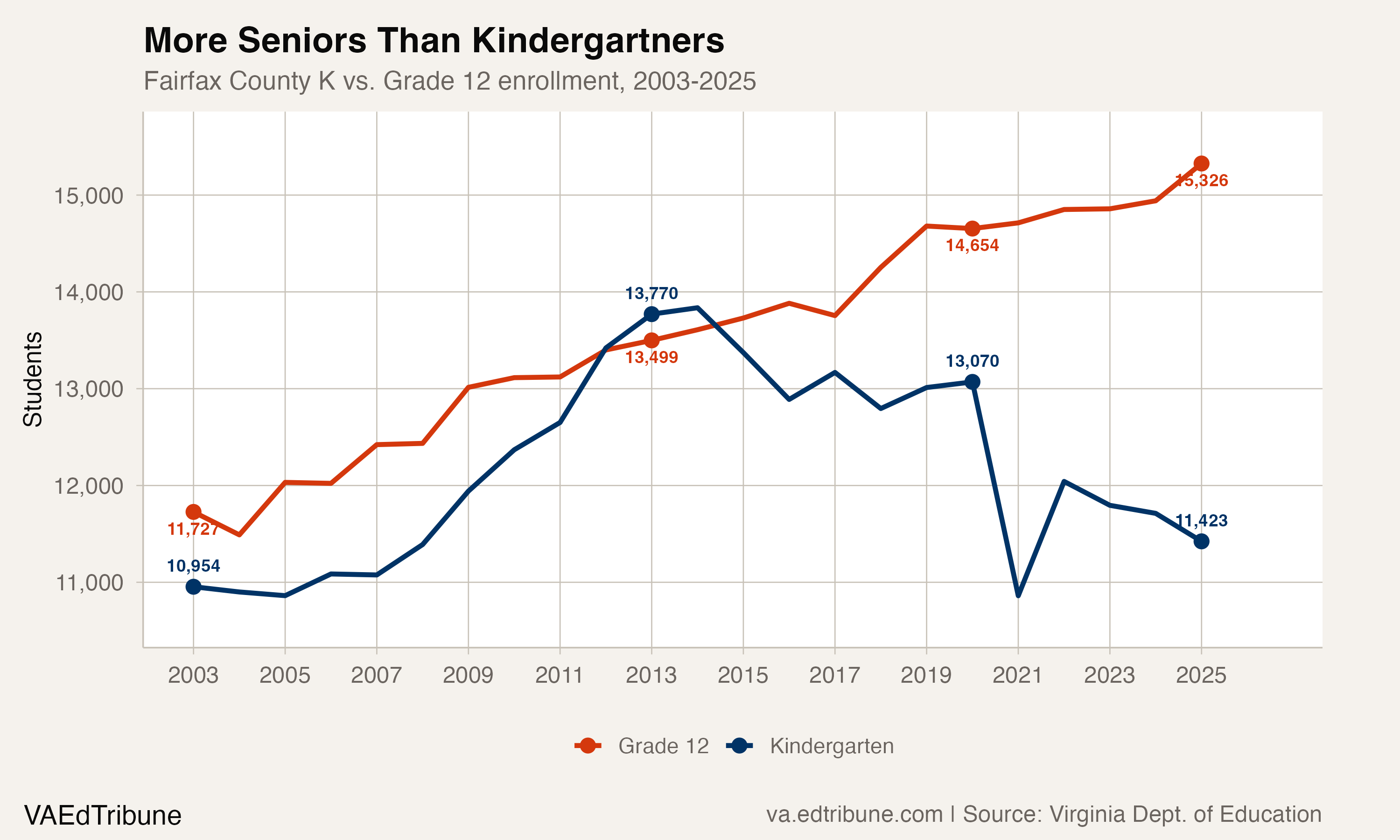
The gap has consequences that compound. Each undersized kindergarten cohort moves through the system for 13 years. The elementary losses visible today will arrive as middle school losses by 2028 and high school losses by 2032.
The population paradox
What makes Fairfax unusual is not the decline itself but its cause. Across most of Virginia, enrollment loss reflects demographic contraction: fewer births, out-migration, and an aging population. Births in Fairfax County fell 15% between 2015 and 2022, a genuine factor. But the county's school-age population still grew, which means birth decline alone does not explain the enrollment shortfall.
The UVA Weldon Cooper Center for Public Service projects a further 5% enrollment decline for Fairfax over the next five years, a loss of roughly 9,235 students, "the single largest numerical decrease statewide" and more than "all the losses in Southwest Virginia put together." Researcher Hamilton Lombard framed the broader demographic pressure:
"Currently, there are nearly as many Virginians turning 65 as 18." -- Cardinal News, Jan. 2024
But Fairfax's gap between population and enrollment points to something beyond demographics. Before the pandemic, more than 90% of Virginia-born children enrolled in public kindergarten. By fall 2023, that share had dropped to roughly 85%. In Fairfax, a wealthy county where families have the resources to exercise alternatives, the shift has been more pronounced. One analysis estimated that private school enrollment in the county more than doubled from about 14,500 in 2019 to roughly 33,500 in 2025, though FCPS does not independently track non-public enrollment.
Statewide, homeschooling has surged in parallel. Virginia now has 66,117 homeschooled students, up 49.5% from pre-pandemic levels, according to data obtained from the Virginia Department of Education through public records requests. The 2022 Lab Schools Act has added another channel: 15 college-partnership lab schools now serve more than 3,800 students across partnerships with over 60 divisions and 20 universities, with enrollment projected to exceed 5,000 within four years.
A region in retreat
Fairfax's loss is the largest in Northern Virginia, but the pattern extends across most of the region. Of eight NoVA divisions, only Alexandria↗ET (+306) and Falls Church (+28) have exceeded their 2020 enrollment. Loudoun↗ET lost 2,355, Prince William↗ET lost 1,641, and Arlington↗ET lost 165.
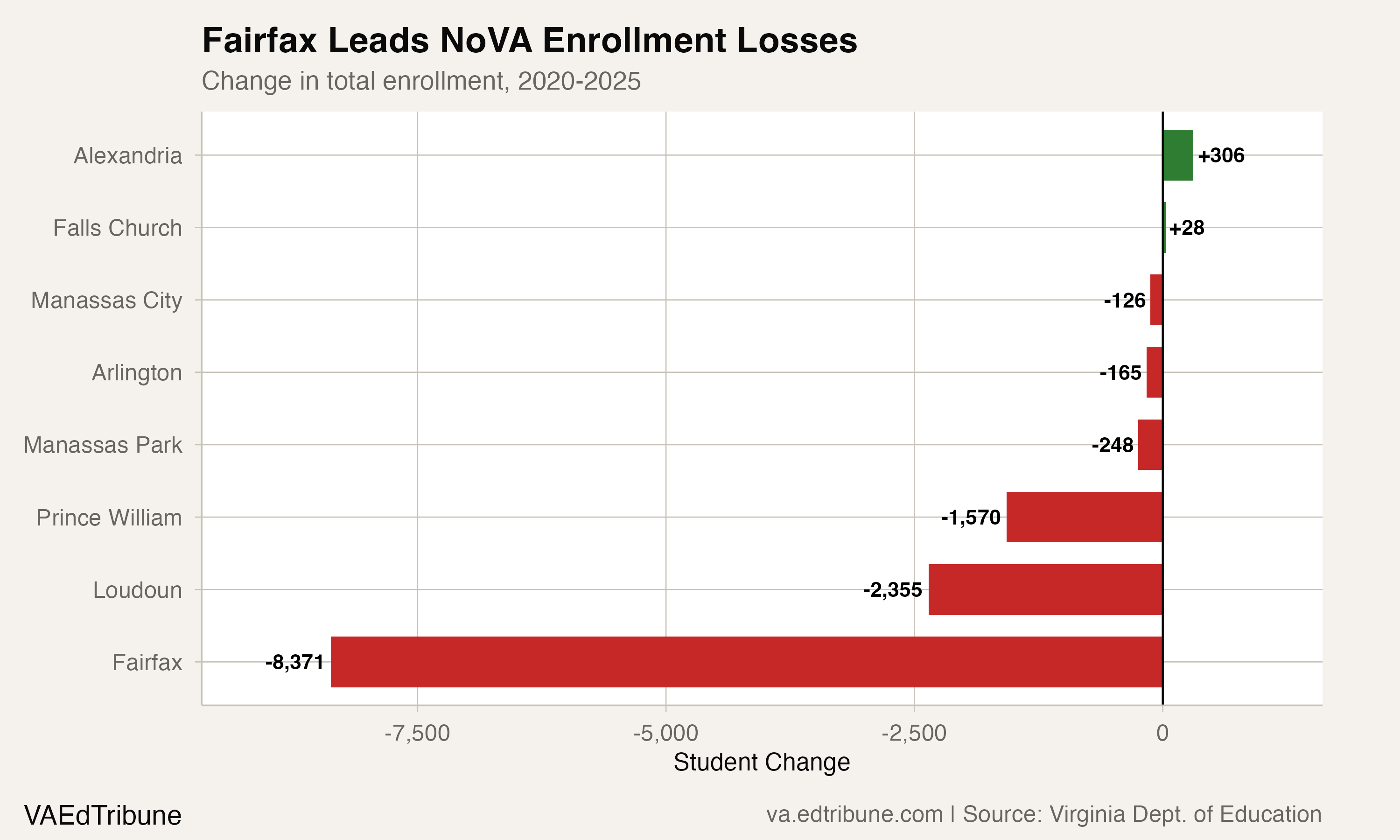
Fairfax accounts for about 65% of NoVA's combined enrollment loss since 2020. That share is disproportionate to its size: Fairfax enrolls about 44% of the region's students. The division's decline is not merely the region's decline at scale; it is significantly worse.
A changing student body
Even as total enrollment contracts, the composition of Fairfax's student body continues to shift. White enrollment has fallen from 77,015 in 2010-11 to 64,717 in 2024-25, a decline of 12,298 students, or 16.0%. White students now make up 35.8% of the division, down from 44.1% in 2010-11.
Hispanic enrollment has moved in the opposite direction, growing by 15,495 students over the same period, a 41.7% increase. Hispanic students now represent 29.2% of Fairfax enrollment, up from 21.3%. Asian enrollment has held roughly steady at 18.5%.
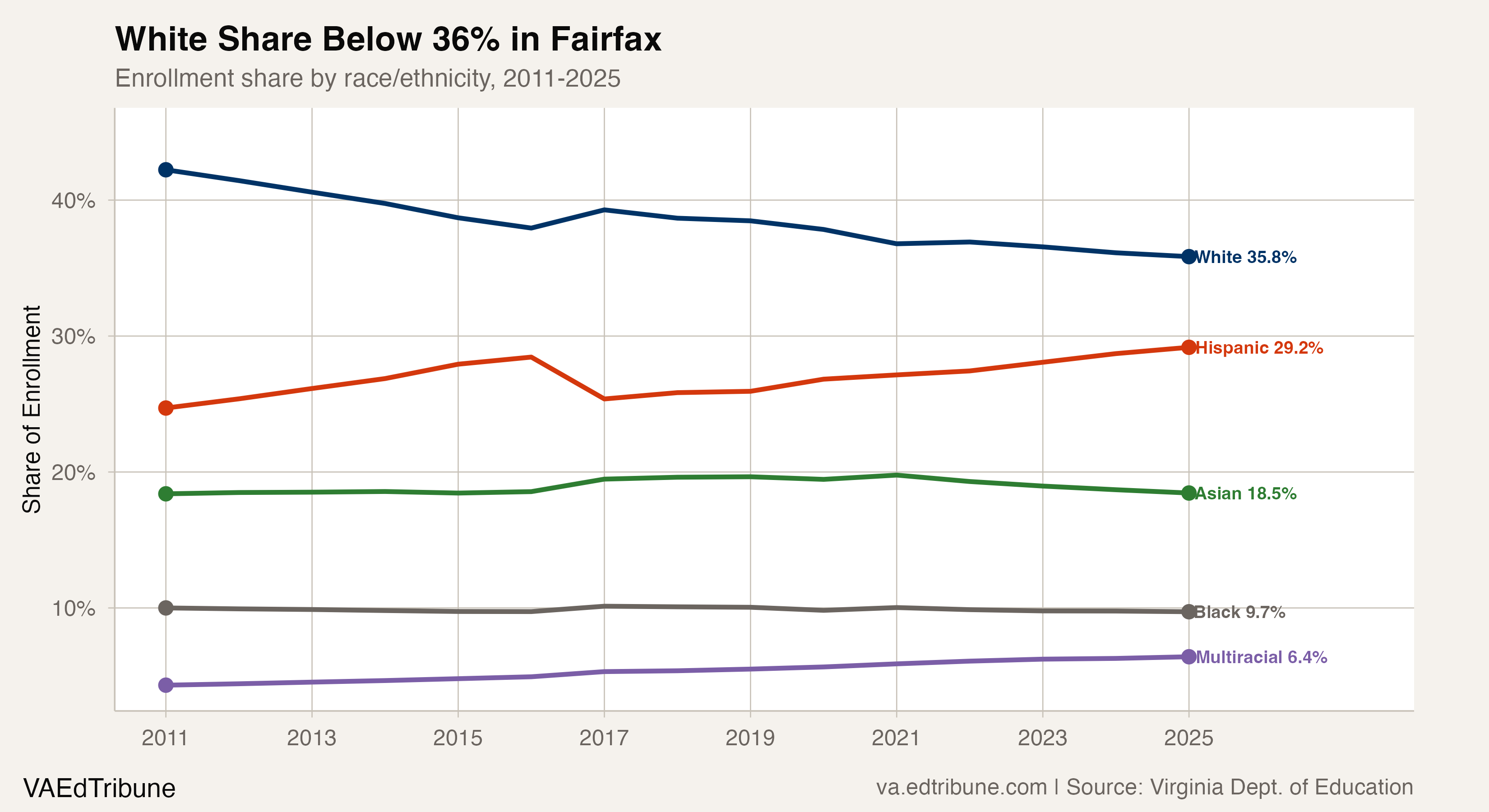
Since 2020, the losses have been concentrated among white and Asian families: white enrollment fell by 6,776 (-9.5%) and Asian enrollment by 3,441 (-9.4%). Hispanic enrollment grew by 1,986 (+3.9%) and multiracial enrollment by 881 (+8.2%). The pattern is consistent with families choosing private alternatives, though the enrollment data alone cannot confirm the mechanism. What is clear is that the students entering Fairfax look different from those leaving it.
The budget that defies the headcount
Despite five years of declining enrollment, FCPS proposed a $4 billion budget for fiscal year 2026, a 7.9% increase over the prior year. Superintendent Michelle Reid framed it as "fiscally responsible," citing the need to address "chronic state underfunding" and "the changing needs of today's students."
The request landed on a county government facing a $292.7 million budget shortfall of its own, driven by falling commercial property values and rising labor costs. Supervisor Jimmy Bierman put it bluntly:
"A $300 million shortfall isn't just going to take care of itself." -- FFXnow, Dec. 2024
The tension is structural. FCPS depends on the county for roughly 80% of its $3.7 billion operating budget. Enrollment-driven state funding declines as students leave. But the costs of running 198 school buildings do not. The division faces a $14.4 billion capital backlog and $244.6 million in deferred maintenance.
Board member Rachna Sizemore Heizer addressed the paradox directly:
"It's not a one-to-one for students in schools. There's a lot of common school spaces that need to be renovated, regardless of whether the school's at 100% capacity, 90% or 110%." -- FFXnow, Jan. 2025
The year-over-year signal
The annual pattern is worth watching because it reveals how growth decelerated long before the pandemic. Fairfax added 2,000 to 3,300 students per year from 2008 to 2015. From 2016 through 2018, annual gains ranged from just 293 to 1,654, and 2019 brought an outright loss of 761 students. The division was already losing momentum before the pandemic erased a decade of growth in a single year.
The post-pandemic trajectory suggests Fairfax has settled near 180,000 students, 4.4% below peak. The division is still budgeting and maintaining 198 buildings for a student body that peaked five years ago, carrying a $14.4 billion capital backlog and $244.6 million in deferred maintenance.
Virginia has no statewide school-choice voucher program. Multiple education savings account bills have failed to advance in the General Assembly. If such a program were enacted, the enrollment impact on a division like Fairfax, where families already have the means to choose, would be substantial. But the paradox at the center of Fairfax's situation does not require a voucher to operate. The county's school-age population grew. Its public school enrollment shrank. By one estimate, roughly 33,500 students are now in private schools, more than double the pre-pandemic count. Those families made a choice without a subsidy. The $4 billion budget request is for the students who remain.
Detailed code that reproduces the analysis and figures in this article is available exclusively to EdTribune subscribers.
Discussion
Sign in to join the discussion.
Loading comments...