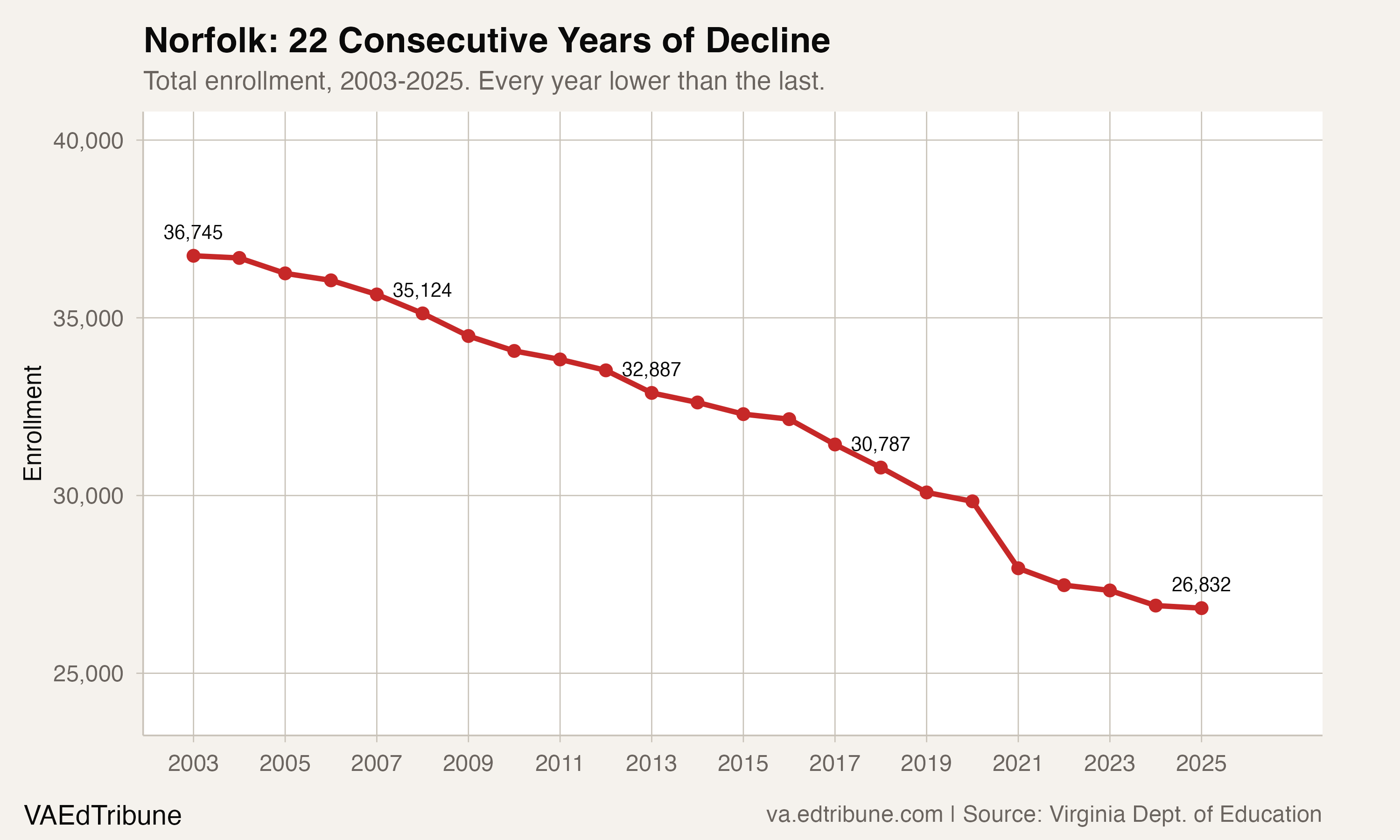
Norfolk Public Schools↗ET enrolled 36,745 students in 2002-03. In 2024-25, the count was 26,832. Between those two years, enrollment fell every single year: 22 consecutive annual declines, a streak no other Virginia division has matched. The loss of 9,913 students, a 27.0% decline, amounts to an average of 451 students vanishing from the rolls each year. The division has never, in the entire span of available data, posted a year of growth.
On March 18, 2026, the Norfolk School Board unanimously approved the first phase of a closure plan that will shut nine school buildings and repurpose four others through 2034. Acting Superintendent Jeff Rose told the board the plan was not driven by a desire to close schools, but by the need to "focus and funnel our resources as best we can."
The question for Norfolk is not whether the decline will end. It is how many buildings will be left when it does.
The acceleration no one outran
Norfolk's decline has not been steady. It has been accelerating.
From 2003 to 2010, the division lost 2,677 students, an average of 382 per year. From 2010 to 2015, the pace eased slightly to 356 per year. Then it picked up: 491 per year from 2015 to 2020, and 601 per year from 2020 to 2025. The most recent five-year period represents a 10.1% drop, the steepest in the dataset.
The COVID-era loss of 1,883 students in 2021 was the single worst year on record, a 6.3% plunge. But unlike Virginia as a whole, which partially recovered in 2023, Norfolk never bounced back. The division lost another 476 students in 2022, 148 in 2023, 426 in 2024, and 72 in 2025.
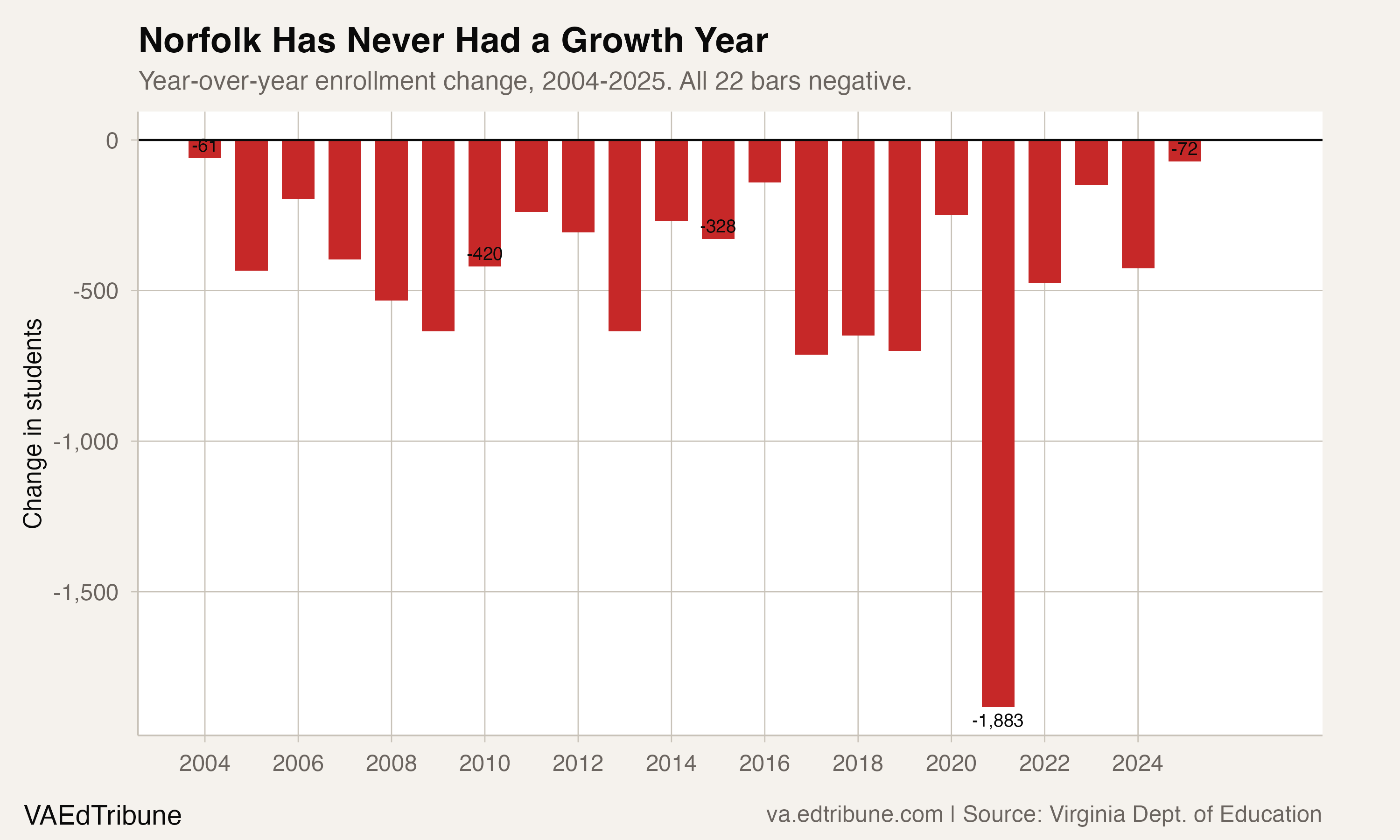
That 2025 figure, a loss of just 72 students, is the smallest annual decline since 2004. Whether it signals a floor or a brief pause before further drops is the central uncertainty facing the school board as it plans a decade of closures.
Diverging from the state
Norfolk's trajectory is not merely a local version of Virginia's broader enrollment trends. The state grew from 1,176,128 students in 2003 to a peak of 1,298,012 in 2020, a 10.4% increase. During that same period, Norfolk shed 18.8% of its students. Indexed to 2003, Virginia's enrollment sits at 107.3% of its starting point. Norfolk sits at 73.0%.
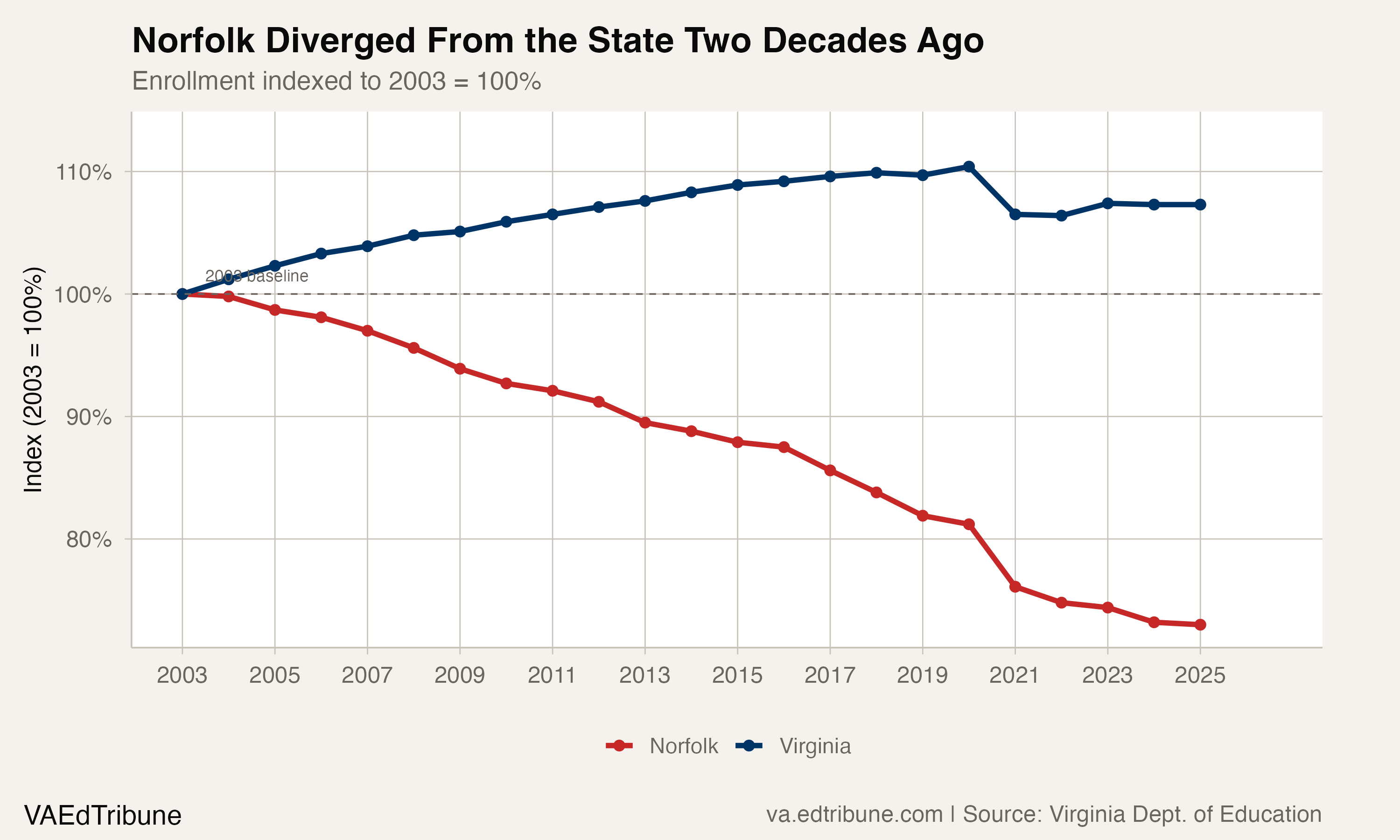
Norfolk's share of statewide enrollment has fallen from 3.12% in 2003 to 2.13% in 2025. The division that was once Virginia's fourth-largest urban district now enrolls fewer students than Chesterfield County, which hit an all-time high of 64,254 the same year Norfolk hit an all-time low.
A regional pattern, but Norfolk is the outlier
Norfolk's decline is part of a broader Hampton Roads story. Five of the six major divisions in the region have shrunk since 2003. Virginia Beach↗ET has lost 11,079 students (-14.6%). Newport News↗ET has lost 6,954 (-21.1%). Portsmouth↗ET has lost 3,066 (-19.2%). Hampton↗ET has lost 3,521 (-15.3%). Only Chesapeake↗ET, the region's suburban growth magnet, has gained, adding 1,305 students (+3.3%).
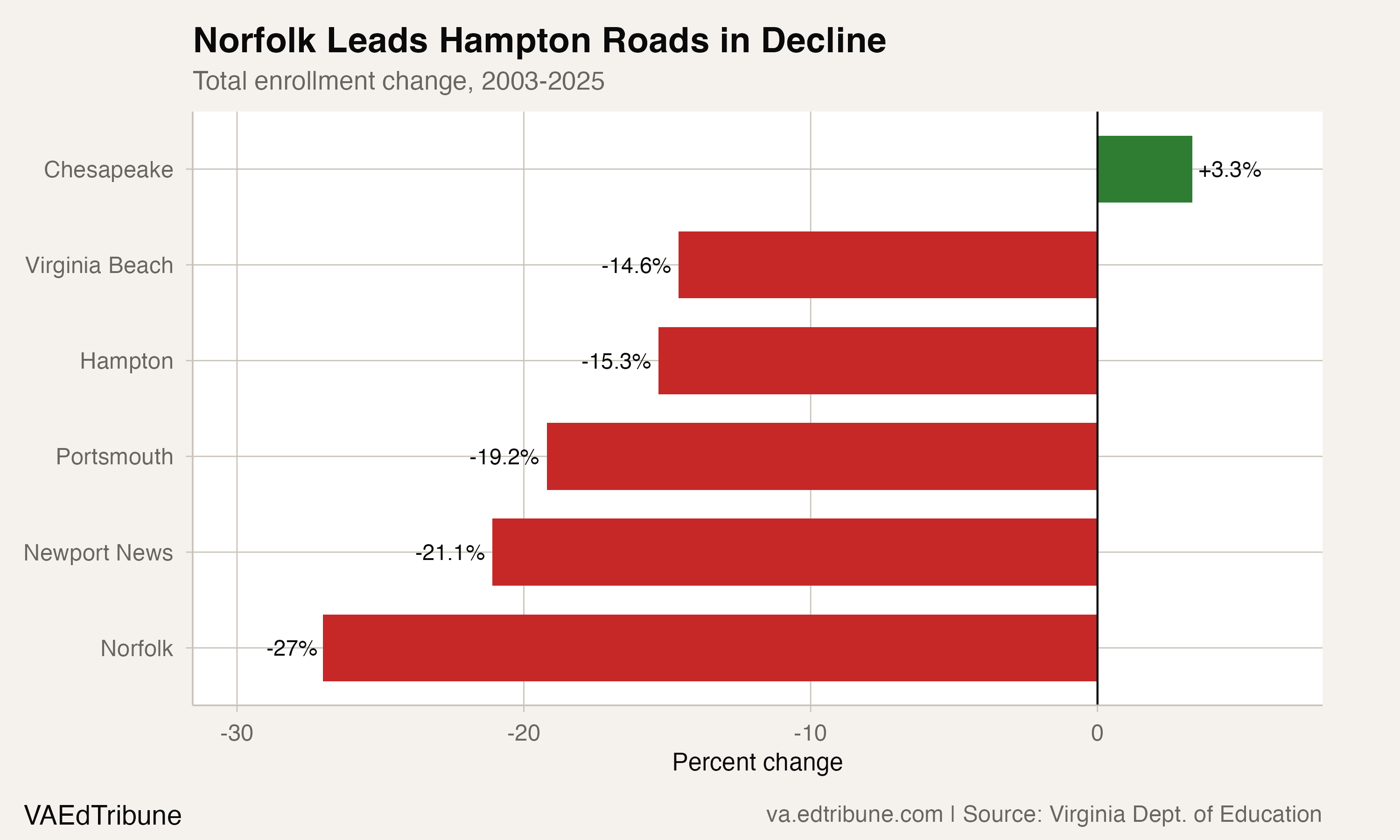
But Norfolk's 27.0% loss is nearly double the next-worst performer, Newport News at 21.1%. And Norfolk's losses predate the regional pattern. Hampton Roads as a whole began losing population in the late 2010s, driven by outmigration rather than a birth-rate shortfall. Norfolk's enrollment decline started two decades earlier.
The $81 million question
The fiscal math behind Norfolk's closures is straightforward. A 2022 study by consulting firm Cooperative Strategies found that Norfolk had been operating with three to 17 more schools than its enrollment justified every year since 2013. The estimated cost of that excess capacity: $81 million over the decade, or roughly $8 million per year.
Per-pupil expenditures in the division doubled from approximately $10,000 in 2014 to $20,000 by 2024, according to the consulting firm's data. Declining enrollment means the fixed costs of maintaining buildings, from HVAC systems to roofing, are spread across fewer students.
"The city cannot afford to operate a school system sized for yesterday's enrollment." -- City Council Member Tommy Smigiel, WHRO, September 2025
The closure plan is ambitious in scope. Willoughby Early Childhood Center and Norview Elementary were scheduled to close by summer 2026. Four more elementary schools, Tarrallton, Granby, Ghent, and P.B. Young, are scheduled to close in 2027. Berkley Early Childhood Center follows in 2029. The technical education center relocates to Lake Taylor High School by 2030-32. The district has said no teachers or staff will lose their jobs as a result of consolidations.
The plan also has a fiscal sword hanging over it. City Manager Pat Roberts has warned that future casino revenue, once projected at $30 million annually but now expected at $15 million, will be largely consumed by debt payments on the new Maury High School, reaching $13 million per year by 2030. The capital improvement backlog across the division stands at nearly $900 million.
Who has Norfolk lost?
The enrollment losses have not been evenly distributed across racial groups. Norfolk is a majority-Black division, and Black students have borne the largest absolute loss: 5,159 students since 2011, a 25.8% decline. White enrollment fell by a similar rate (-27.3%, or 1,955 students) but from a much smaller base. Hispanic enrollment is the one group that has grown, from 3,867 students (11.4% of the total) to 4,220 (15.7%), a gain of 353 students, or 9.1%.
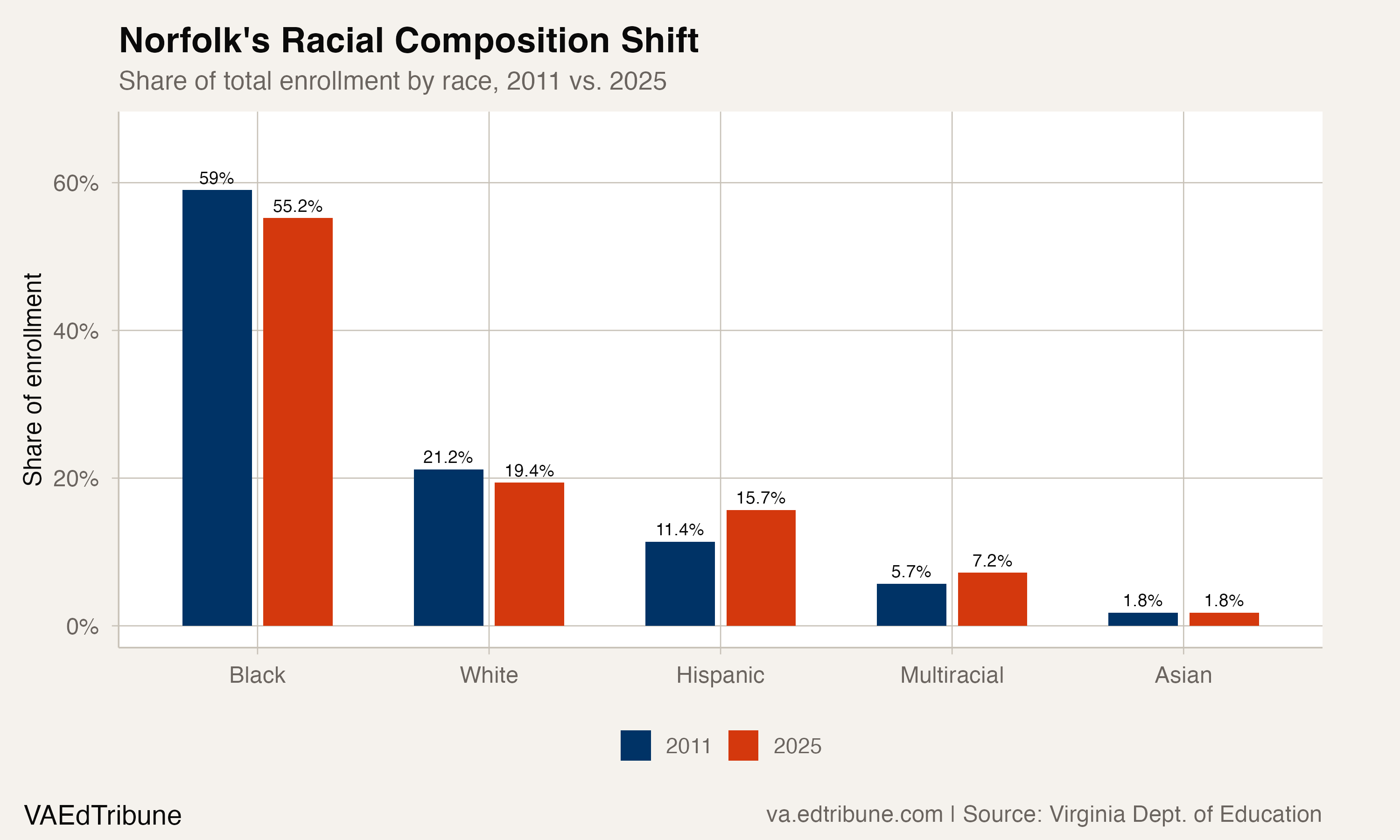
Norfolk remains a majority-Black school division at 55.2%, but that share has fallen from 59.0% in 2011. The demographic shift mirrors a citywide transformation. Norfolk's population has declined 4.2% since the 2020 census, falling from 237,813 to an estimated 227,751, with outmigration as the primary driver.
Roots of a two-decade exit
No single factor explains a 22-year enrollment decline. Multiple forces have compounded over time, and their relative contributions are difficult to isolate.
The most direct factor is population loss. Norfolk is an independent city, meaning it cannot annex surrounding counties for tax base or population growth the way Chesapeake or Virginia Beach can absorb suburban development. The city's population has been shrinking since 2010, and the school-age cohort has shrunk with it. Hampton Roads localities overall are losing residents to outmigration at rates that exceed their natural population increase.
Housing costs are a contributing pressure. The Hampton Roads housing market has tightened, with regional median prices rising to $345,000, which may push families with children toward more affordable submarkets in Chesapeake or Suffolk. The city's ambitious St. Paul's redevelopment, which demolished the Tidewater Gardens housing complex, has displaced families whose children attended nearby schools, though the long-term plan calls for mixed-income housing that could eventually bring some families back.
Virginia's statewide birth decline is another headwind. Kindergarten classes are already running 10,000 students smaller than they were in 2019, and UVA's Weldon Cooper Center projects continued statewide losses through the decade. Norfolk, with its already-depleted enrollment base, has less margin to absorb these losses than growing divisions in Northern Virginia or the Richmond suburbs.
The military dimension is harder to quantify. Norfolk is home to Naval Station Norfolk, the world's largest naval base, and the Hampton Roads region has 71,080 military-connected students (5.6% of state enrollment). Military families cycle through on multi-year rotations, and the Navy's persistent base housing shortage may push some families to live in adjacent jurisdictions like Virginia Beach or Chesapeake while stationed at Norfolk installations.
What the closure plan cannot fix
The school closures will reduce Norfolk's building maintenance burden and consolidate staff. They will not reverse the enrollment trend.
The division's elementary enrollment (grades 1 through 5) fell from 14,992 in 2003 to 10,192 in 2025, a loss of 4,800 students, or 32.0%. High school enrollment (9-12) declined from 8,501 to 7,289, a smaller 14.3% drop, reflecting the time lag between when a smaller cohort enters kindergarten and when it reaches graduation. That pipeline contraction means the high school losses are still catching up to the elementary losses, with further shrinkage baked in for the next several years.
The school board acknowledged this reality in its planning process. Board member Tanya Bhasin told WHRO that "our decisions must be driven by what improves outcomes for students, not solely by what alleviates fiscal pressures." The tension between those two goals will define the next decade for Norfolk schools.
The first closures were scheduled for summer 2026. The enrollment data will determine how many more follow.
Detailed code that reproduces the analysis and figures in this article is available exclusively to EdTribune subscribers.
Discussion
Sign in to join the discussion.
Loading comments...