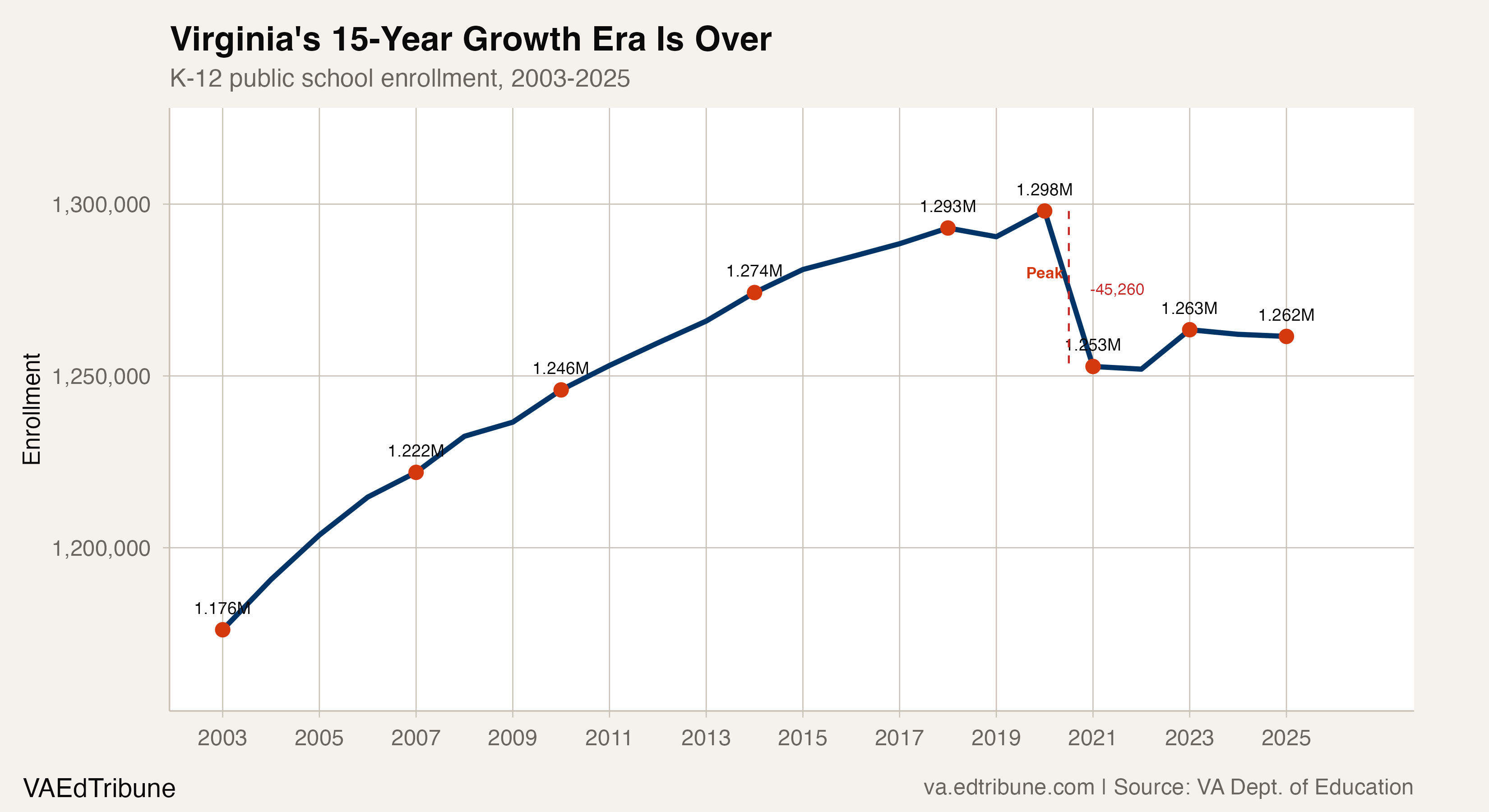
For 15 consecutive years, Virginia's public schools grew. Enrollment rose in every school year from 2003-04 through 2017-18, climbing by 116,921 students from its 2002-03 level, driven by Northern Virginia's suburban expansion and steady immigration. The system peaked at 1,298,083 in fall 2019 (the 2019-20 school year).
Then COVID hit, and 45,331 students vanished in a single year.
Five years later, only 8,918 have come back. That is a 19.7% recovery rate, leaving Virginia with 1,261,670 students in 2024-25, the most recent school year in the state's published data, and still 36,413 below its pre-pandemic peak. Three of the last four years have been declines. The Weldon Cooper Center for Public Service at UVA projects another 36,827 students lost by 2030.
The pandemic did not create Virginia's enrollment problem. It accelerated a transition that was already underway: births had been falling for a decade, the state's school-age population was aging, and the first enrollment dip arrived in 2018-19, a full year before any lockdown. COVID turned a gradual deceleration into an acute crisis, and the recovery that followed has been shallow enough to suggest that much of the loss is permanent.
The growth era and its end
Virginia added students every year from 2003-04 to 2017-18, with gains above 10,000 in three of the first four of those years. By 2015-16, the annual increase had slowed to fewer than 4,000 students, and in 2018-19, enrollment fell for the first time in the dataset: a modest 2,536-student decline. A brief rebound in 2019-20 (up 7,570) preceded the COVID crash.
The 2020-21 loss of 45,331 students, a 3.5% single-year drop, dwarfs everything else in the 23-year record. One partial recovery year followed (2022-23, up 11,635), then the slide resumed: down 1,343 in 2023-24 and down 592 in 2024-25.
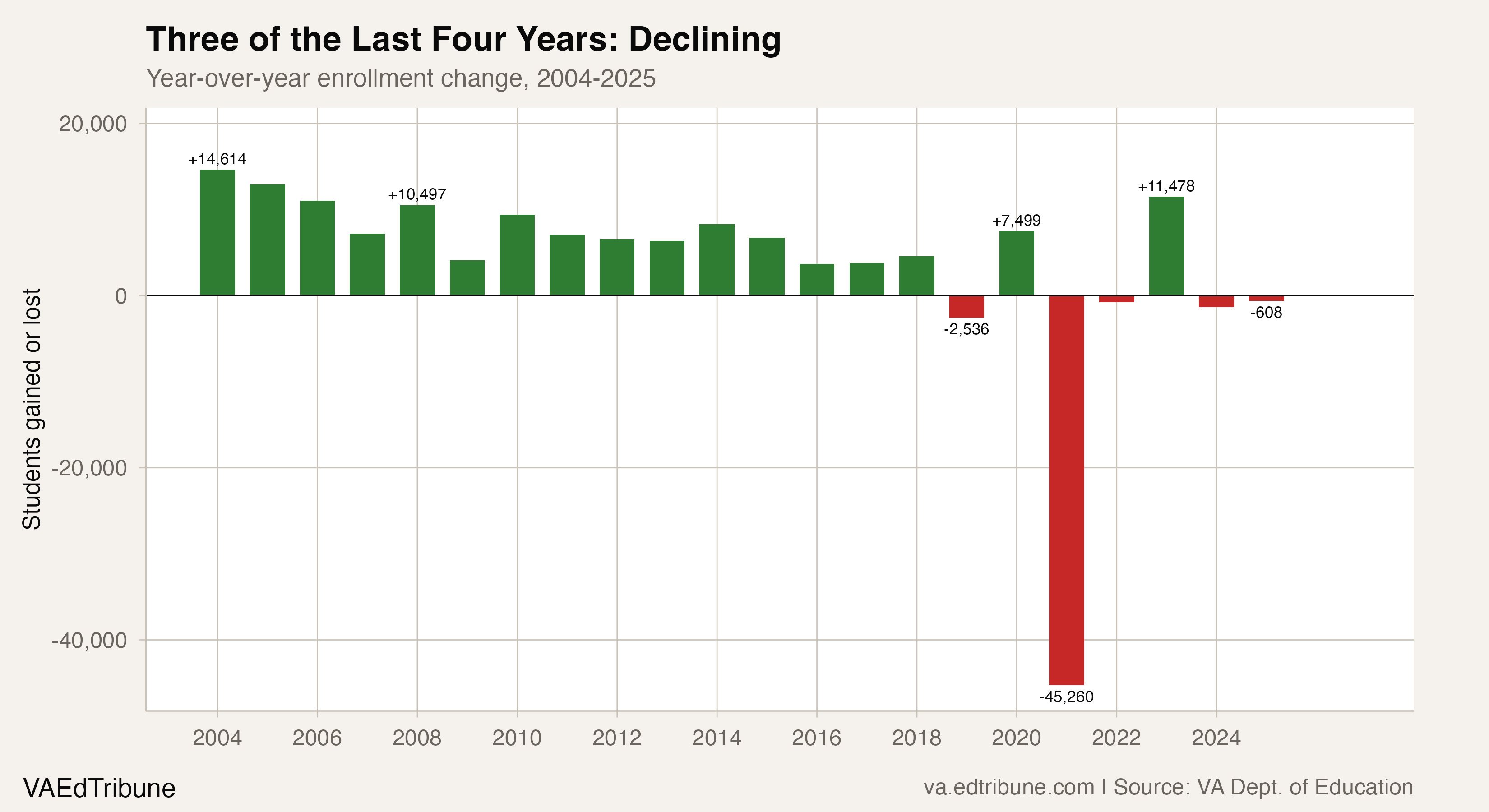
The post-COVID trajectory is not a recovery with occasional dips. It is a plateau that tilts downward. Virginia has now posted five decline years out of the last seven (2018-19, 2020-21, 2021-22, 2023-24, 2024-25). The system is 36,413 students smaller than it was in 2019-20, and the Cooper Center's projection model suggests it will not return to that level during the 2020s.
The 2019-20 peak carries one caveat. VDOE's school-level enrollment file and its division-level file differ slightly that year, all of the difference in Prince William County, and the state did not retain a separate statewide figure. On the school-level count the peak is slightly lower, but the recovery rate still rounds to 19.7% and every comparison in this article points the same way.
Where the students went
Three forces are pulling students out of Virginia's public schools at the same time, making the loss structural rather than cyclical.
Fewer children are being born. Virginia's annual births have fallen in 11 of the last 17 years of available data, and the 2024 birth total trails the 2007 peak by 14,422 births, a 13.3% decline, according to the Cooper Center. Between 2015 and 2022, births in Fairfax County dropped 15%, and in Arlington County↗ET they fell by nearly a quarter. The Cooper Center estimates Virginia's population under age 10 is 15% smaller than those in their 20s, meaning the pipeline of future kindergartners is significantly narrower than the graduating cohorts in the data.
Homeschooling has surged and stayed high. More than 56,000 Virginia students were homeschooled in 2024-25, according to one count. The Home Educators Association of Virginia's tally climbed to 66,117 in 2025-26, a 5.3% single-year increase, 49.5% above 2019-20 and the highest level it has recorded. Unlike other states that saw homeschooling spike and then revert, Virginia's numbers have kept climbing.
Families with means are choosing private schools. Before the pandemic, more than 90% of Virginia-born children enrolled in public kindergarten. By fall 2023, that share had dropped to approximately 85%. The shift is most visible in Fairfax County↗ET, where the number of private school students more than doubled from 14,500 in 2019 to about 33,500 in 2025, according to the Washington Examiner.
Virginia does not have a voucher or education savings account program. But the state's lab schools, backed by $100 million in appropriations, have created a growing alternative: VDOE's 2025 report to the legislature counts 15 College Partnership Lab Schools, six of which were operating in fall 2024.
74% of divisions still below pre-pandemic levels
The statewide 19.7% recovery rate obscures wide variation at the division level. Only 34 of the 130 divisions that can be compared across both years (26.2%) have recovered to their 2019-20 enrollment. The other 96 remain below where they stood in fall 2019. Alleghany Highlands is left out of that count: it formed in 2022-23 when Alleghany County absorbed Covington, so its apparent gain since 2019-20 is a merger, not a recovery. Counted on the two former divisions' combined 2019-20 enrollment, it would be one more division below its pre-pandemic level.
The largest absolute shortfalls concentrate in the state's biggest systems. Fairfax is down 8,371 students from 2019-20 (188,930 to 180,559). Virginia Beach↗ET is down 3,883. Richmond City↗ET is down 3,785. Norfolk↗ET is down 3,005. Newport News↗ET is down 2,722. Together, these five divisions account for nearly 60% of the statewide shortfall.
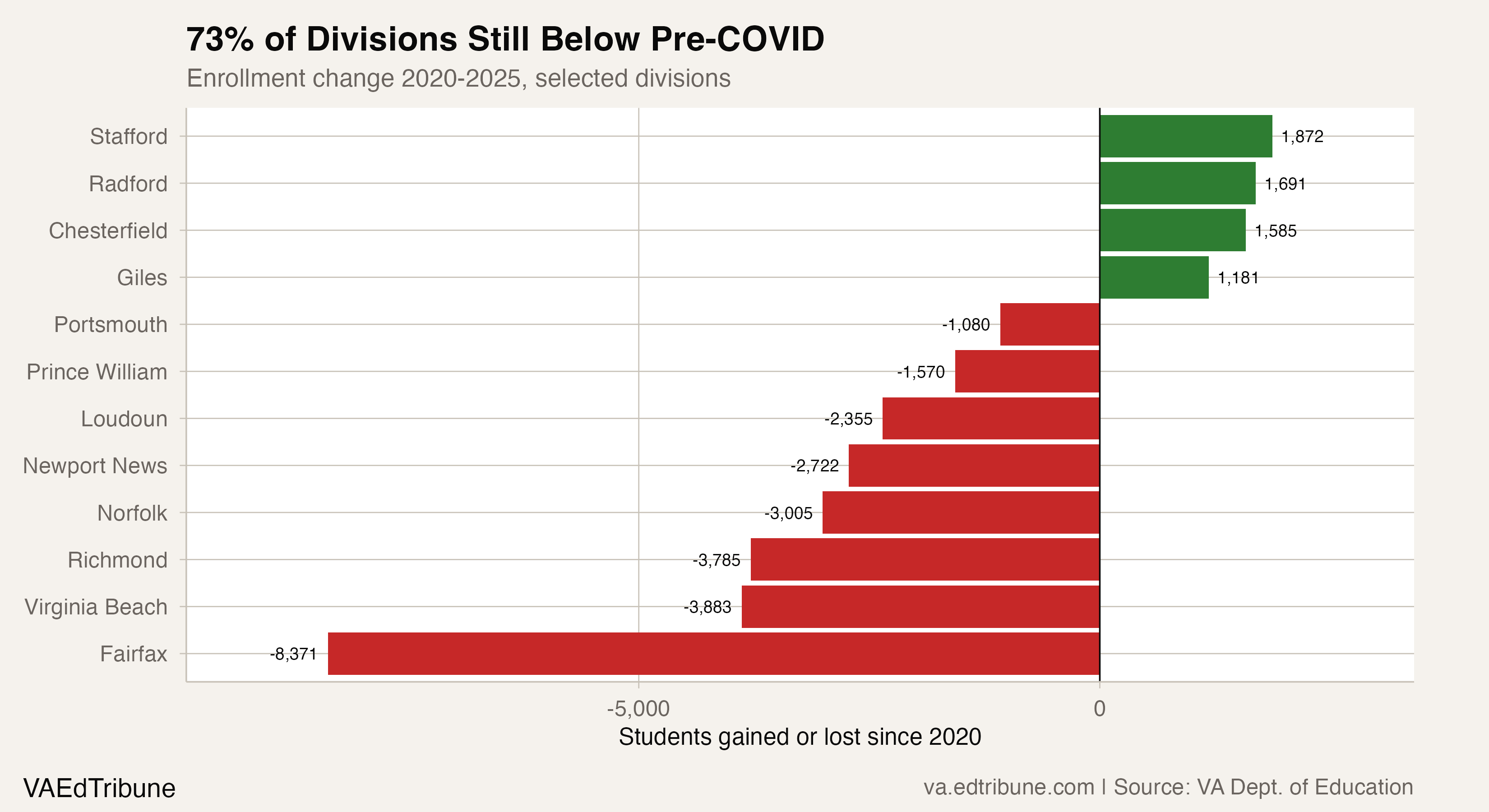
The divisions that have recovered tend to be suburban and exurban. Stafford County↗ET gained 1,872 students since 2019-20 and sits at an all-time high of 31,992. Chesterfield County↗ET added 1,585. Some apparent recoveries are a different kind of growth: Radford City more than doubled, from 1,642 students to 3,333, and Giles County also grew. Both divisions run K-12 virtual schools listed in VDOE's School Quality Profiles (Radford City Virtual and Giles County K-12 Virtual School), so their gains may say little about local families.
Norfolk's 22-year freefall
Norfolk holds a distinction no other Virginia division approaches: 22 consecutive years of enrollment decline, every single year in the dataset from 2003-04 to 2024-25. The Navy city enrolled 36,745 students in 2002-03 and 26,832 in 2024-25, a loss of 9,913 students (27.0%).
The school board voted in October 2025 to close nine schools in stages through 2033, after a consultant estimated the division could have saved $70.6 million between 2018 and 2022 by closing unneeded buildings sooner.
"Our hands have been forced with this plan, but we have gone through many iterations of this plan, and I stand fully behind it. But our kids are resilient, and they will bounce back quicker than the adults." -- Norfolk School Board Chair Sarah DiCalogero, WHRO, October 2025
Norfolk is the sharpest example, but 43 of the 130 Virginia divisions with an unbroken record since 2002-03 (33.1%) were at all-time lows in 2024-25. Virginia Beach (64,823 students, down 15.0% from its 2003-04 peak) and Newport News (25,933) are among the largest divisions at record-low enrollment.
A different state than a decade ago
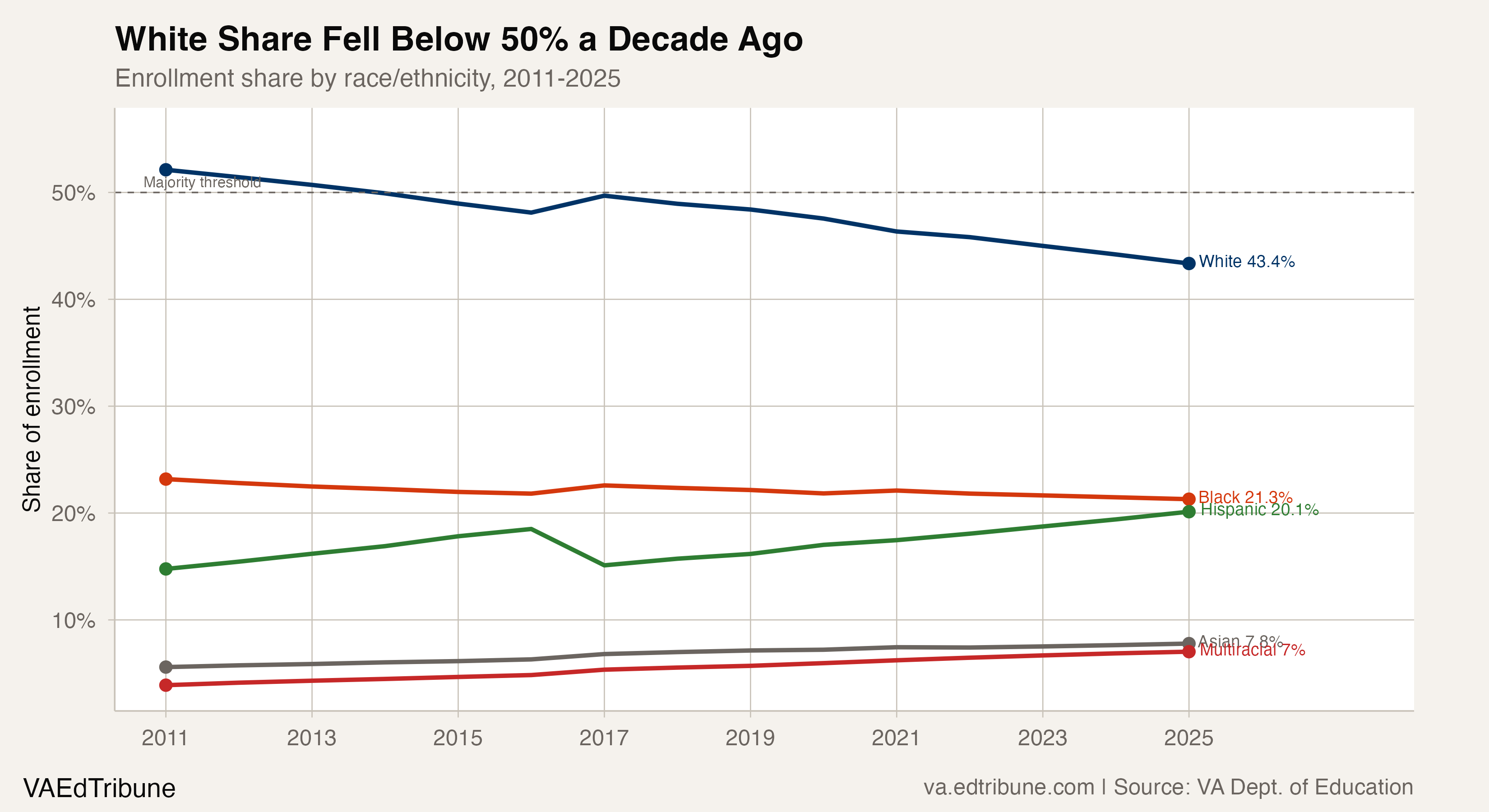
While total enrollment has flatlined, the composition of Virginia's student body has transformed. White students dropped below 50% of enrollment in 2016-17, making Virginia a majority-minority public school system for nearly a decade. By 2024-25, white students made up 43.4% of enrollment, down from 54.1% in 2010-11, a loss of 131,067 students (19.3%).
Hispanic enrollment crossed 20% for the first time in 2024-25, reaching 253,895 students (20.1%), up from 142,707 (11.4%) in 2010-11. That 77.9% increase makes Hispanic students the fastest-growing group in the state's race and ethnicity counts. The gap between Black and Hispanic enrollment, which stood at 158,871 in 2010-11, has narrowed to 14,850. If it keeps shrinking at its average pace since 2016-17, about 10,200 students a year, Hispanic students would outnumber Black students as the second-largest group in the 2026-27 school year.
Multiracial students are close behind, growing 73.1% from 51,214 (4.1%) to 88,643 (7.0%) since 2010-11. Asian enrollment grew 34.1% over the same period, reaching 98,189 (7.8%).
These shifts carry direct operational consequences. The number of students classified as limited English proficient grew 8.5% in just two years, from 172,913 in 2022-23 to 187,596 in 2024-25, and more than one in seven Virginia students (14.9%) now qualifies. Two divisions, Manassas City (52.3% LEP) and Manassas Park (50.7%), are now majority-LEP, concentrating demand for bilingual teachers and ESOL programs in two small Northern Virginia cities.
The pipeline is inverting
Virginia now enrolls more 12th graders than kindergartners, and the gap is widening. In 2024-25, 97,429 students were in 12th grade while only 84,376 were in kindergarten, a K-to-G12 ratio of 86.6. Kindergarten has been smaller than 12th grade for eight consecutive years, since 2017-18.
Kindergarten peaked at 96,935 in 2012-13 and has since fallen 13.0%. Twelfth-grade enrollment hit a record 97,429 in 2024-25. The system is sending out more students at the top than it is receiving at the bottom, and the imbalance is growing.
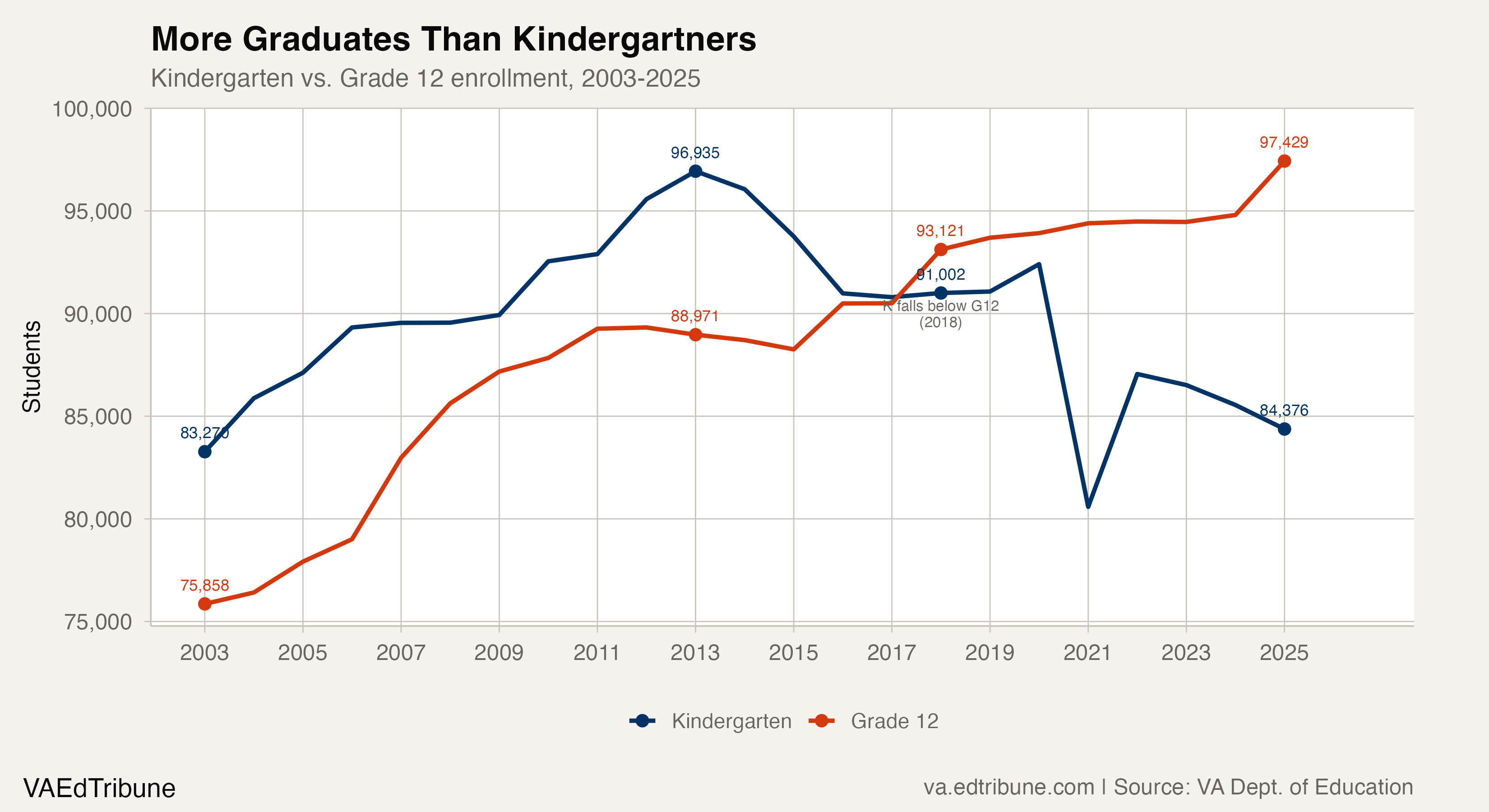
This matters for planning because elementary schools are already feeling the squeeze. Elementary enrollment (K-5) peaked at 580,088 in 2014-15 and has fallen to 544,115, a loss of about 36,000. High school enrollment (grades 9-12) peaked only in 2023-24 at 401,324 and has just begun to decline. The pipeline contraction that has been reshaping elementary schools for a decade is now arriving at the secondary level.
The building problem
Virginia's enrollment trajectory is not a mystery. The demographic math points in one direction. The harder problem is what to do with school buildings sized for a system of nearly 1.3 million students when enrollment keeps drifting lower.
Norfolk's nine-school closure plan is the most visible answer, but it will not be the last. Fairfax is losing families to private schools. Virginia Beach has shed 11,474 students since its 2003-04 peak. In the Shenandoah Valley and I-81 corridor, divisions that are simultaneously shrinking and becoming more Hispanic need bilingual teachers they struggle to recruit and ESOL programs they struggle to fund. The data says less about whether the decline will continue than about how many superintendents will be forced to close schools, cut programs, or both before their boards are ready.
Correction (October 3, 2026): An earlier version of this article relied on state files that left two state-operated programs out of the 2022-23 through 2024-25 statewide totals and, for 2010-11, counted multiracial students as Hispanic as well while understating every other group. On the corrected data, Virginia has recovered 19.7% of its pandemic enrollment loss, not 19.3%, and the headline has been updated from 19% to 20%. White students fell below 50% of enrollment in 2016-17, not 2013-14, and Hispanic students, not multiracial students, are the fastest-growing group since 2010-11. The 2019-20 peak, the year-to-year changes, the division recovery count and the race figures have been corrected, and several outside figures that could not be matched to their cited sources were removed or re-sourced.
Detailed code that reproduces the analysis and figures in this article is available exclusively to EdTribune subscribers.
Discussion
Sign in to join the discussion.
Loading comments...